

Get ready to be inspired in just about the time it takes to brew a cup of tea (about 2 minutes)! And if you’ve got your feet up and that tea’s still hot, we’ve got a whole buffet of brilliance waiting for you on our menu.
A message from today’s meditation:
Two little words that might be able to tell us something about dealing with the onslaught of daily noisiness and overwhelm. Two little words formed from the very same alphabet soup of letters…. silent and listen… is it a beautiful coincidence that they’re made of the exact same letters, or a message waiting for us to get it?
Life can be a whirlwind of thoughts, emotions, and external noise. We chase solutions, analyze problems, and then we yearn for a sense of peace, while overlooking the simplest answer: silence. But why is silence so hard to find? Perhaps because it hasn’t been woven into the fabric of our education. We’re programmed to seek answers, fix problems, and constantly strive. Yet, within the quietude lies a portal to a deeper understanding of ourselves and the world around us.
There’s a natural resistance within many of us to embrace silence. It feels counterintuitive. Surely, the answer to life’s complexities must also be intricate and elusive, right? It can’t be that simple can it?
“Meditation is all about coming alive, right now! In meditation, we invite our attention to come out of the drama and complexity of our lives, out of the already-lived past and the uncertain future, and to return to this precious moment, the only moment there is. It’s about being in contact with life as it happens; with breathing, with the heart beating, with all the sounds and smells and sensations of this unique, unrepeatable, irreplaceable instant of our lives.” – Jeff Foster
“Meditation has nothing to do with trying to fix ourselves, change ourselves, attain spiritual states or have special experiences. All kinds of states, experiences, thoughts and feelings may come and go during meditation, of course, but they are not the goal. There is no goal – that’s the beauty of it! Just an invitation to be the space in which all thoughts, all feelings, all urges, even uncomfortable ones, can come and go, arise and fall freely. Meditation has nothing to do with trying to get there, wherever we think there is. It’s all about being here; allowing ourselves to be exactly as we are, curious about the present scene in the movie of our lives.” – Jeff Foster
This approach doesn’t ask for perfection, but for presence… When we truly listen – to ourselves, to the moment, to the subtle whispers of intuition – we tap into a wisdom that no amount of external noise can drown out. In the silence between thoughts, between breaths, between heartbeats, we find the clarity we’ve been seeking.
Join the quiet revolution. In a world that profits from your distraction, choosing silence becomes a radical act of self-love and wisdom.
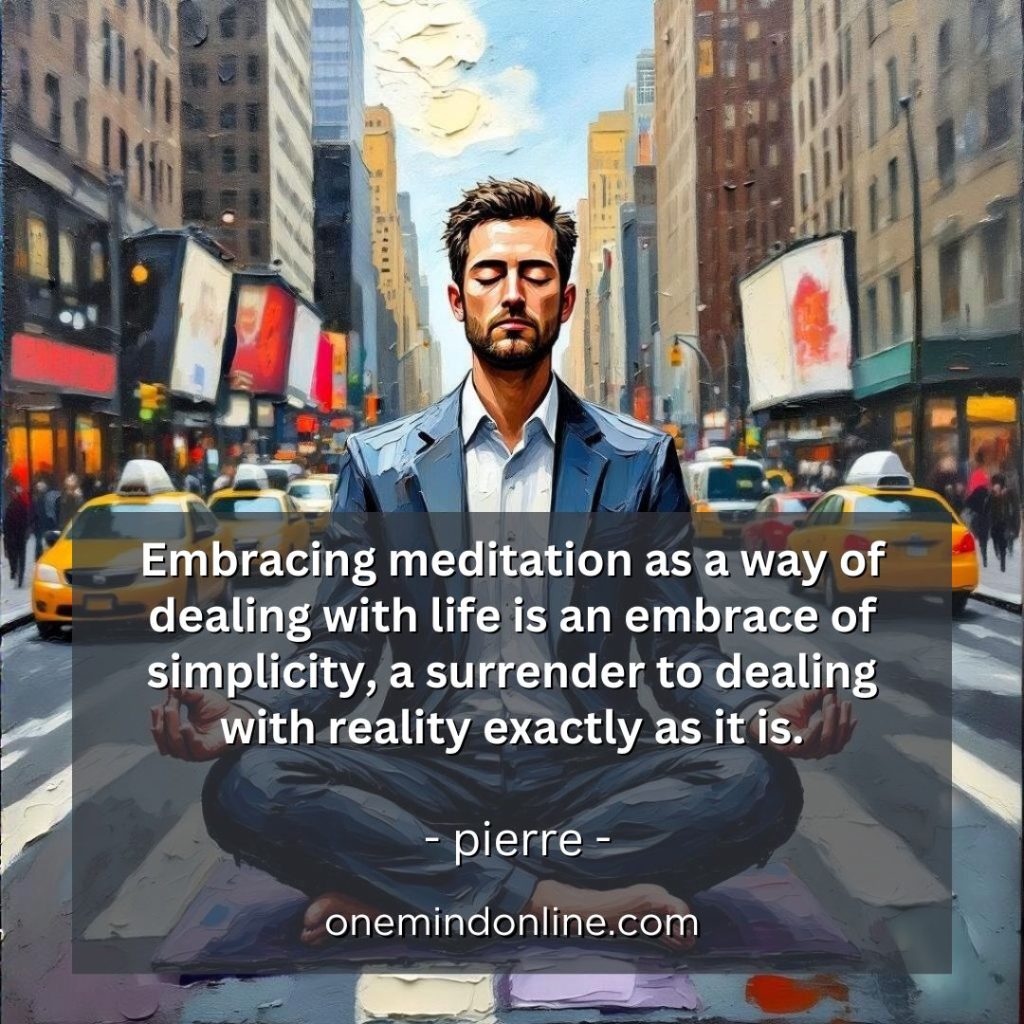
Embracing meditation as a way of dealing with life is an embrace of simplicity, a surrender to dealing with reality exactly as it is.
So, how do we find this elusive silence? Here are a few guiding mantras for self-reflection:
- Notice the noise: Start by becoming aware of the constant chatter in your mind. Acknowledge it without judgment.
- Take a mindful breath: Focus on your breath, fill the balloon in your belly, and slowly let it deflate. As you soften, allow your body to relax.
- Let go of expectations: There’s no pressure to achieve a specific state during meditation. Simply be present.
- Observe, don’t judge: Thoughts, feelings, and bodily sensations will arise. Notice them without judgment, then let them go.
Remember, silence is not about stopping your thoughts. It’s about creating a space where thoughts can exist without controlling you. It’s about finding peace amidst the chaos. Join us on our journey towards a more mindful life, one quiet moment at a time.
– pierre –
Today’s LIVE meditation is: Finding silence.
A moment of reflection
(If you have the time, use this question as a journal prompt, because whenever you put pen to paper you’re wiring the neural pathways that create your new habits. But if you don’t have the time, just take a moment to reflect on your response.)
The Language of Silence: The article explores how “silent” and “listen” are formed from the same letters—a beautiful reminder that true listening requires inner quiet. A trap we fall into easily while listening, is being caught up in formulating our next response as soon as the speaker takes a breath, being more invested in our own reply than truly listening to understand. Reflect on a recent moment when you felt truly heard by someone, or when you felt you truly heard another person. What conditions were present that allowed for this deep listening? How might cultivating more inner silence change the quality of your relationships and your ability to understand yourself and others?
Today’s LIVE meditation
https://youtu.be/J_CO7yRUMAc 2025
https://youtu.be/r0nNUoWlHTM 2024
https://youtu.be/sBwWLIo4gcc 2023
https://youtu.be/bHOcscBF6CY 2020
Q&A for deeper learning
1. What’s the connection between “silent” and “listen”?
These two words are formed from exactly the same letters, which serves as a beautiful reminder that true listening requires inner quiet. When we become silent—not just externally but internally—we create space to truly hear what’s happening within us and around us. This isn’t mere coincidence; it points to a fundamental truth about how deep understanding emerges from stillness rather than mental noise.
2. I can’t stop my thoughts during meditation. Am I doing it wrong?
Not at all! This is one of the biggest misconceptions about meditation. The goal isn’t to stop thoughts—it’s to change your relationship with them. As Jeff Foster explains, meditation is about “being the space in which all thoughts, all feelings, all urges, even uncomfortable ones, can come and go, arise and fall freely.” Think of yourself as the sky, and thoughts as clouds passing through. The sky doesn’t try to control the clouds; it simply allows them to move naturally.
3. Why does silence feel so uncomfortable or scary to some people?
Our education and culture have programmed us to constantly seek, fix, and strive. We’re conditioned to believe that solutions must be complex and that we always need to be “doing” something. Silence can feel foreign because it asks us to simply “be.” Additionally, when we get quiet, we might encounter emotions or thoughts we’ve been avoiding. This discomfort is natural and actually signals that the practice is working—you’re creating space to meet parts of yourself that need attention.
4. How is meditation different from relaxation techniques?
While relaxation might be a byproduct of meditation, it’s not the goal. Meditation is about cultivating present-moment awareness regardless of whether you feel calm or agitated. You might have a meditation session filled with restless thoughts or difficult emotions, and that’s still “successful” meditation if you’re observing what’s happening with curiosity rather than resistance. Relaxation techniques aim to change your state; meditation aims to change your relationship to whatever state you’re in.
5. What does it mean to “surrender to dealing with reality exactly as it is”?
Surrender in this context doesn’t mean giving up or becoming passive. It means releasing the exhausting habit of mentally fighting against what’s already happening. Instead of spending energy wishing your anxiety away, your financial situation were different, or your relationships were perfect, you acknowledge the current reality with acceptance. This doesn’t mean you can’t take action to improve things—but you act from a place of clarity rather than resistance.
6. How can I find silence in a busy, noisy world?
External silence isn’t always necessary for inner silence. You can cultivate this inner quiet even in noisy environments by focusing on your breath, becoming aware of physical sensations, or simply observing your thoughts without getting caught up in them. The “silence” we’re seeking is more about mental spaciousness than absence of sound. Even a few conscious breaths can create this inner sanctuary, regardless of what’s happening around you.
7. What’s the difference between meditation and thinking about my problems?
Thinking about problems typically involves analyzing, planning, worrying, or trying to mentally solve issues. Meditation involves observing whatever arises—including thoughts about problems—without getting entangled in the content. When a worry comes up during meditation, instead of following the worry down its usual path, you notice “worry is here” and allow it to be present without feeding it with more analysis. This creates space for insights to emerge naturally rather than forcing solutions through mental effort.