

“Your Daily Dose” is a quick two minute read packed with bite-sized wisdom from all the great teachers. But you could also choose to turn it into something more… a powerful daily practice for personal growth. Give it a try!
A message from today’s meditation:
We get bombarded with a lot of self-help messages about the importance of “positive vibes” and “good energy.” But what happens when life throws you a curveball – a frustrating setback, a stinging criticism, a moment of pure sadness? Do we need to try and turn everything into a constant stream of sunshine and rainbows?
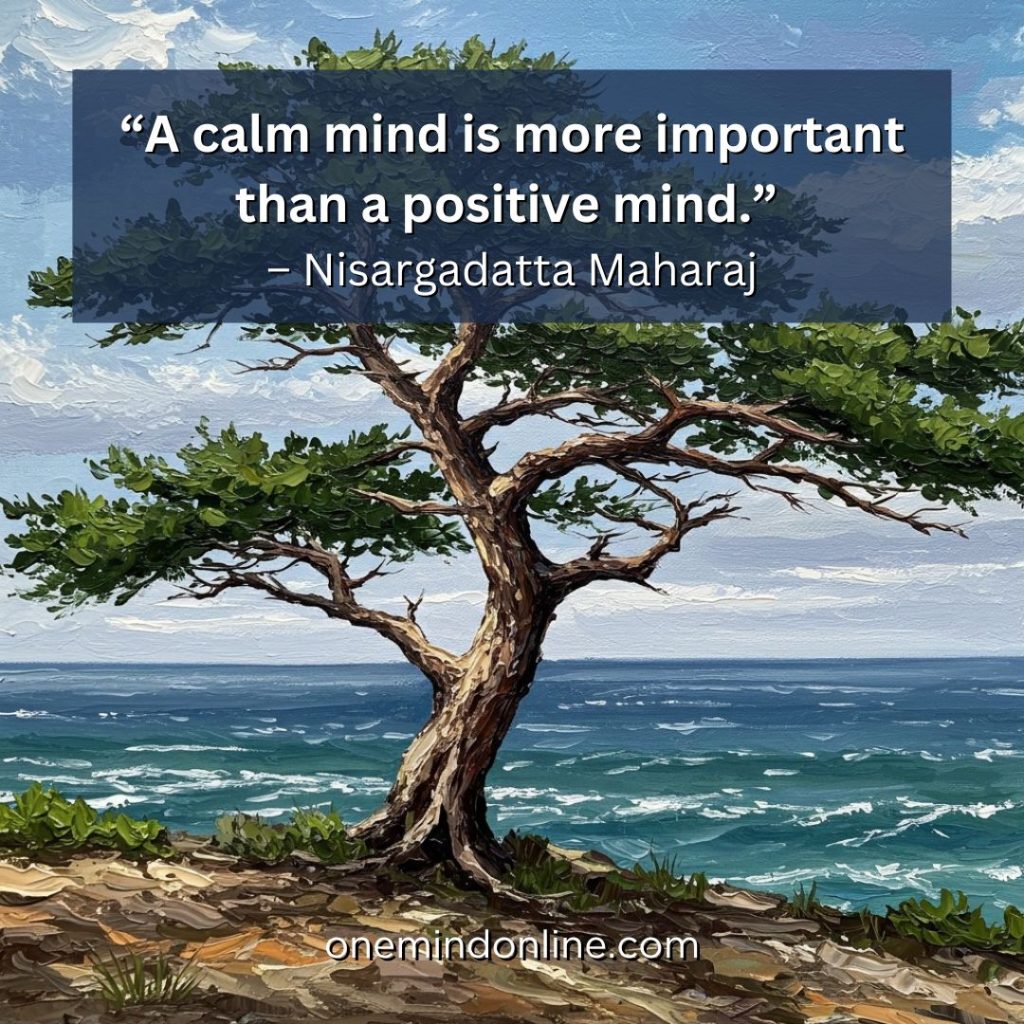
“A calm mind is more important than a positive mind.” – Nisargadatta Maharaj
Today’s meditation is a journey of our outer senses – sight, hearing, smell, taste and touch.
Is it important that the experience our senses give us must always be “positive” and not ever “negative”? How do you feel about it when the feedback you get from your senses is not enjoyable?
The truth is we can’t have only positive experiences, but with a calm mind we can look at each experience for what it is and be, OK, whether it’s positive or negative.
Can we apply this equally to our inner senses?
“Whatever state I am in, I see it as a state of mind to be accepted as it is.” – Nisargadatta Maharaj
Just like with our outer senses, the experience generated by our inner senses comes and also goes.
Whatever I practice, I become better at. If I consistently practice resistance toward everything I don’t want to feel, then I’m becoming better at feeling stressed, feeling anxious and creating a storm in my pond. However, if what I’m practicing is to accept the feeling without resistance, knowing I’ll be OK even if this feeling is not “nice”… then what I’m getting better at is having a calm mind. I’m creating a more consistently calm pond.
A calm mind fosters resilience. It understands impermanence – that whatever arises will eventually pass. This allows us to navigate challenges with a clear head and make thoughtful choices, rather than being swept away by the current of our emotions.
A few questions for self-reflection:
- “I can be okay, no matter what I feel.”
- “I am the stillness that exists beneath every passing feeling.”
- “What I practice, I become – and I choose to practice returning to calm.”
- “Whatever arrives will also pass. I can rest in that truth.”
By reflecting on these questions and incorporating practices like meditation, we can cultivate a calm mind that allows us to navigate the storms of life with grace and clarity. Remember, a still pond reflects reality most accurately.
The calm mind knows that whatever comes will also go. Enjoy your weekend!
– pierre –
Today’s LIVE meditation is: Come to your senses.
https://youtu.be/23oRl2FeERc 2026
https://youtu.be/hEvn6BdkpEo 2025
https://youtu.be/lFPmc4iyEBk 2024
https://youtu.be/qksMIyizgno 2023
Today’s LIVE meditation
Practice the “Daily Dose”
Let’s put it into practice! Choose what works for you – daily, once a week or whenever inspiration strikes. Putting pen to paper wires the neural pathways that will create your new habits.
1 – Affirmation
Write down your favourite affirmation on a sticky note and place it somewhere that you’ll be able to see it the whole day.
- “I can be okay, no matter what I feel.”
- “I am the stillness that exists beneath every passing feeling.”
- “What I practice, I become – and I choose to practice returning to calm.”
- “Whatever arrives will also pass. I can rest in that truth.”
2 – A moment of reflection
Use today’s question as a journal prompt. If you don’t have the time to sit down and write, just take a moment to reflect on your response.
Nisargadatta Maharaj’s quote states, “Whatever state I am in, I see it as a state of mind to be accepted as it is.” Consider a current internal state you are experiencing that you find challenging. How would it feel to fully accept this state without resistance, viewing it simply as a temporary state of mind? What might you learn from simply observing the current state? What would happen next if you were able to simply take a step back and watch the thoughts and emotions during this state without trying to change them?
3 – Quotes to share
Send a quote to someone who needs it, or share them all on social media to spread the good vibes!


4 – Q&A for deeper learning
Read through the questions and answers and write down at least one “aha moment” that clicked for you.
Q1: The article contrasts a “calm mind” with a “positive mind.” What does it mean by a “calm mind” in this context?
In this context, a calm mind isn’t necessarily about feeling happy or optimistic all the time. Instead, it refers to a state of mental acceptance and non-resistance towards whatever experiences, internal or external, arise. It’s about observing without judgment and understanding the impermanent nature of these experiences.
Q2: Why does the article suggest that a calm mind is more important than a positive mind?
The article suggests this because life inevitably brings challenges and unpleasant experiences. Trying to force constant positivity can be unsustainable and even create more internal conflict when faced with negativity. A calm mind, however, allows us to navigate all experiences, both pleasant and unpleasant, with clarity and resilience, understanding that everything passes.
Q3: The article mentions our outer senses (sight, hearing, etc.) and inner senses (feelings, thoughts). How does the idea of a calm mind apply to our inner experiences?
Just as we can’t always control whether our outer senses receive “positive” or “negative” input, we also can’t always control what our inner experiences “feel” like. A calm mind allows us to accept our thoughts and feelings, even the uncomfortable ones, without resistance. This acceptance prevents us from “creating a storm in our pond” by constantly fighting against what we feel.
Q4: What is the consequence of consistently resisting feelings we don’t want to feel, according to the article?
According to the article, if we consistently practice resistance toward everything we don’t want to feel, we become better at feeling stressed and anxious. This resistance creates more internal turmoil rather than alleviating it.
Q5: How does a calm mind foster resilience?
A calm mind fosters resilience by understanding impermanence – the idea that whatever arises will eventually pass. This understanding allows us to face challenges with a clearer perspective, knowing that the current difficulty is not a permanent state. This helps us make thoughtful choices rather than being overwhelmed by our emotions.
Q6: What is the significance of the metaphor “a still pond reflects reality most accurately” in the context of a calm mind?
The metaphor suggests that when our minds are calm and still, without the ripples of resistance or the distortions of forced positivity, we can see reality more clearly. We can observe our experiences, both internal and external, for what they truly are, without being clouded by judgment or the need for things to be different.