

Below is a 2 minute read to put some sparkle in your day, or… plunge into these topics for a deeper understanding.
A message from today’s meditation:
Happy Friday peeps! I’m sure you know by now that the topic of our Friday meditations is always love, and today is no different.
Our sense of what love even is, is so deeply intertwined with how we have been taught to see ourselves and where we seek validation and acceptance for and of ourselves, that the terms LOVE and SELF-LOVE are completely inseparable.
Much of our childhood experiences might have led us to chase external validation, to the point of losing touch with the person staring back from the mirror. Have you ever felt like a stranger to yourself?
It’s not uncommon to feel this way at all. But wherever it is that you find yourself in your own journey today, the foundational work for each and every one of us is to become friendlier to that human we see looking back at us.
We didn’t have any one specific teacher for our messages this week, so for today I searched through some of my own writing on the topic of love:
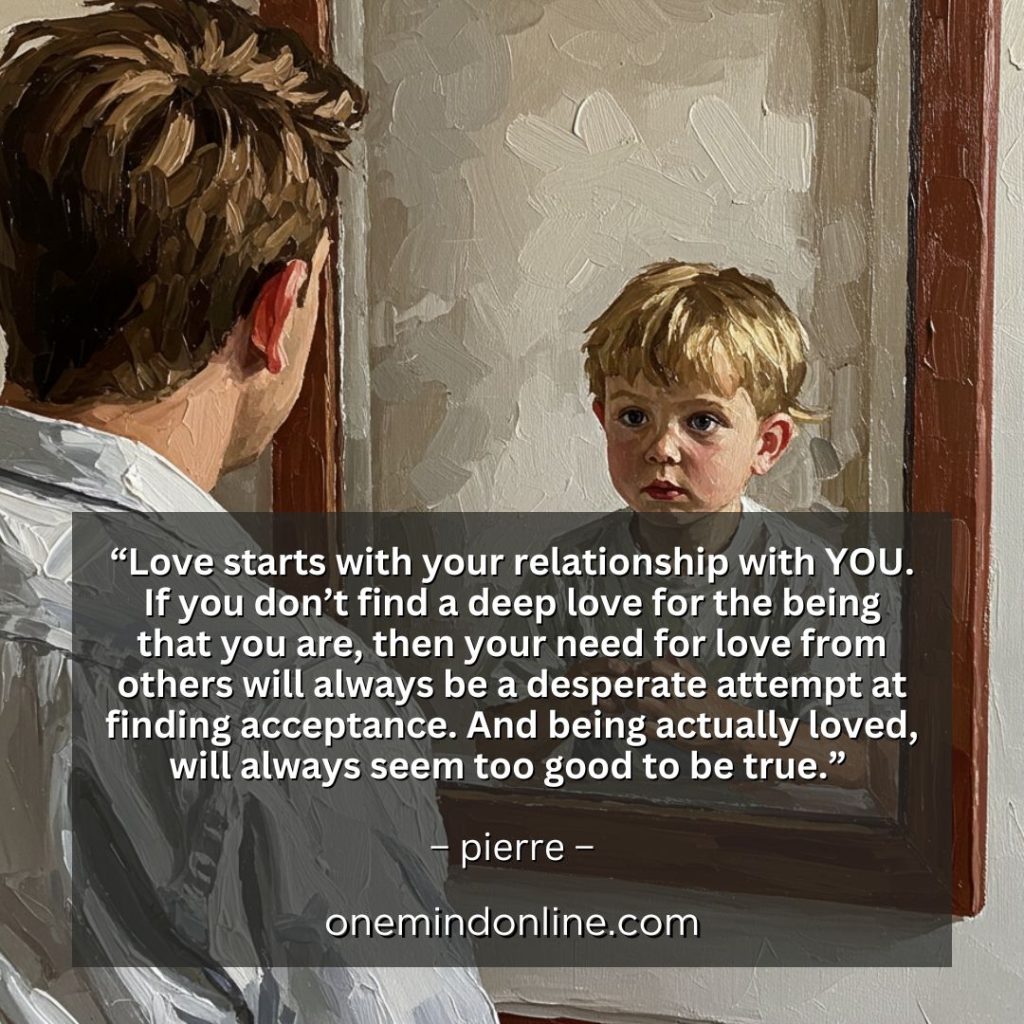
“Love starts with your relationship with YOU. If you don’t find a deep love for the being that you are, then your need for love from others will always be a desperate attempt at finding acceptance. And being actually loved, will always seem too good to be true.” – pierre –
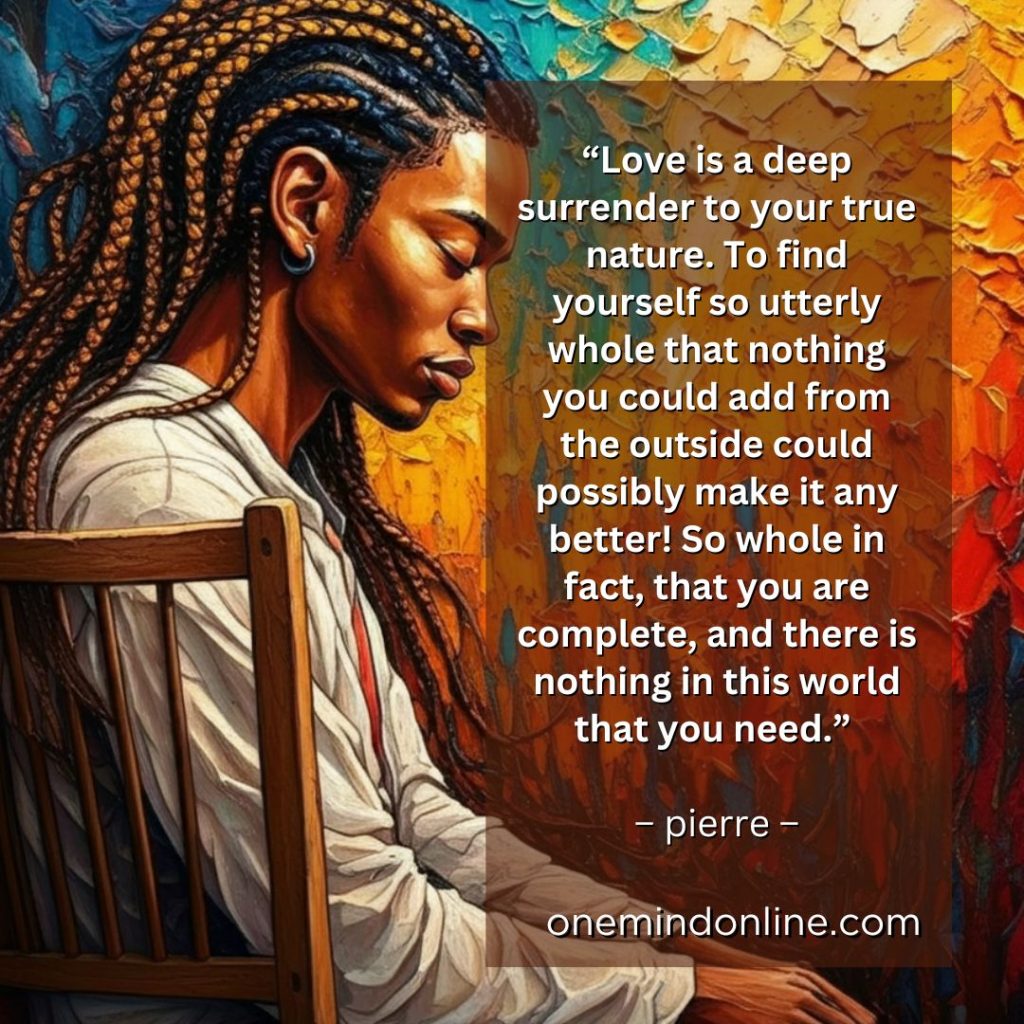
“Love is a deep surrender to your true nature. To find yourself so utterly whole that nothing you could add from the outside could possibly make it any better! So whole in fact, that you are complete, and there is nothing in this world that you need.” – pierre –
“It is when you realize that every “part” of you has really been trying its utter best to fight for your survival, that you start falling in love with YOU.” – pierre –
I’m including a poem by Derek Walcott that describes a process which I have seen become true for clients over and over again…
———-
Love After Love
The time will come when, with elation you will greet yourself arriving at your own door, in your own mirror and each will smile at the other’s welcome, and say, sit here. Eat.
You will love again the stranger who was your self.
Give wine. Give bread. Give back your heart to itself, to the stranger who has loved you all your life, whom you ignored for another,
…who knows you by heart.
Take down the love letters from the bookshelf, the photographs, the desperate notes, peel your own image from the mirror.
Sit. Feast on your life.
– Derek Walcott
———-
When you take the time to revisit all of your imperfections… When you stop turning away from the things about yourself that you find “not quite good enough”, and bring these home to your heart… When you can find yourself saying, “yes, I can love this part of myself too…” – then indeed there will come a time when, with elation you will greet yourself arriving at your own door…
Love is a deep surrender to your true nature, to find yourself so utterly whole that nothing you add from the outside could possibly make it any better.
Here are some guiding mantras to accompany your journey of self-love:
- I am worthy of love, just as I am.
- All parts of me deserve acceptance and compassion.
- My true worth comes from within, not from external validation.
- I am on a journey of self-discovery, and I embrace the process.
- Today, I choose to love myself a little more deeply.
Remember, the greatest love story you’ll ever experience is the one you write with yourself. This is never to try and say that we shouldn’t want to share our lives intimately with another human, but understand that no relationship can reach its true potential while the participants are desperately trying to feed their own wholeness, from each other.
So take a deep breath, embrace your wholeness, and rediscover the love that’s been waiting for you all along.
Have a beautiful Friday beautiful humans!
– pierre –
Today’s LIVE meditation is: Sharing love.
A moment of reflection
(If you have the time, use this question as a journal prompt, because whenever you put pen to paper you’re wiring the neural pathways that create your new habits. But if you don’t have the time, just take a moment to reflect on your response.)
Excavating Your Survival Strategies: Consider the quote: “It is when you realize that every ‘part’ of you has really been trying its utter best to fight for your survival, that you start falling in love with YOU.” Think about the aspects of yourself that you’ve been most critical of—your defense mechanisms, insecurities, or patterns of behavior that you judge as “negative.” Choose one of these traits and explore it deeply: When did this pattern first develop? What was it protecting you from? How has it served you, even if it sometimes causes challenges now? Write a letter of gratitude to this part of yourself, acknowledging how it has been trying to keep you safe. What would it feel like to approach this aspect of yourself with love instead of criticism?
Today’s LIVE meditation
https://youtu.be/jaZu8xG4yfg 2025
https://youtu.be/rJBAo_WAc3I 2024
https://youtu.be/646egaSJyk0 2023
https://youtu.be/0fc8sStU9yI 2022

Q&A for deeper learning
1. What does it mean to “love the stranger who was your self”?
This phrase from Derek Walcott’s poem refers to the process of reconnecting with parts of yourself that you’ve become disconnected from over time. Often, through childhood experiences, societal expectations, or the pursuit of external validation, we lose touch with our authentic selves. The “stranger” represents the real you that has been waiting beneath layers of conditioning and people-pleasing. Learning to love this stranger means greeting your authentic self with curiosity, acceptance, and compassion rather than judgment or rejection.
2. How can I tell if I’m seeking external validation instead of practicing true self-love?
Signs of seeking external validation include constantly needing others’ approval before making decisions, feeling anxious when you don’t receive immediate positive feedback, changing your behavior or opinions based on who you’re with, and feeling empty or worthless when alone. True self-love, on the other hand, creates a sense of inner stability and completeness. You make decisions based on your own values, you can sit comfortably with yourself, and while you appreciate others’ opinions, your self-worth doesn’t depend on them.
3. I’m very self-critical. How do I start loving parts of myself that I consider flaws?
Start by reframing your perceived flaws as protective mechanisms that developed to help you survive. Every defense mechanism, insecurity, or challenging behavior pattern was once your psyche’s attempt to keep you safe. Instead of asking “Why am I like this?” ask “How has this served me?” and “What was this trying to protect me from?” Practice speaking to these parts of yourself as you would to a frightened child who needs reassurance, not criticism. Gradually, you can begin to appreciate these aspects while also choosing to evolve beyond them when they no longer serve you.
4. Does focusing on self-love mean I should avoid intimate relationships with others?
Absolutely not. The goal isn’t to become self-sufficient to the point of isolation, but rather to enter relationships from a place of wholeness rather than desperation. When you love yourself deeply, you’re not trying to use others to fill a void within you. This allows for healthier, more authentic connections where you can truly give and receive love rather than just exchanging mutual neediness. Relationships become about sharing your abundance rather than trying to complete each other.
5. How do I know when I’ve achieved true self-love versus just being narcissistic?
True self-love includes honest self-awareness, including acknowledgment of areas where you can grow. It’s accompanied by genuine compassion for others because you’re not constantly defending your ego. Narcissism, on the other hand, often involves an inflated self-image used to mask deep insecurity, difficulty accepting criticism, and a lack of empathy for others. Self-love makes you more connected to others, while narcissism creates distance and superiority. If you’re genuinely concerned about being narcissistic, that self-awareness itself suggests you’re probably on the right track.
6. What does it practically look like to “feast on your life” as the poem suggests?
Feasting on your life means actively celebrating and appreciating your journey, including both the highs and lows. Practically, this might involve keeping a gratitude journal that includes gratitude for challenges that helped you grow, regularly reflecting on how far you’ve come, treating yourself with the same kindness you’d show a good friend, and making time for activities that nourish your soul. It means savoring your experiences rather than constantly rushing toward the next goal, and finding ways to honor your story rather than dismissing your experiences as insignificant.
7. I understand the concept intellectually, but how do I actually feel love for myself when the emotions aren’t there yet?
Emotional change often follows behavioral change, so start with actions even when the feelings haven’t caught up. Begin with small acts of self-care and self-respect. Speak to yourself using kind language, even if it feels awkward at first. Practice the mantras provided, engage in activities that bring you joy, and treat your body with respect. Work with the journal prompts to explore your inner landscape with curiosity rather than judgment. Often, the feeling of self-love emerges gradually as you consistently practice treating yourself as someone worthy of love. Consider working with a therapist or counselor who can help guide this process, as sometimes professional support is invaluable in developing a loving relationship with yourself.