
“Your Daily Dose” is a quick two minute read packed with bite-sized wisdom from all the great teachers. But you could also choose to turn it into something more… a powerful daily practice for personal growth. Give it a try!
A message from today’s meditation:
Our subconscious holds what I like to call a “recording” of the past. Our whole body understands this old recording as “the truth”, because these are the things that, in fact, we did live through. And so like a well-worn record, the meaning we’ve made in the past – the dots we’ve connected subconsciously – are played on repeat, shaping our perceptions, actions, and ultimately forming our beliefs and our entire reality.
In this recording, you have created a view of YOU that is based not necessarily on truth, but on the feedback you received about yourself from the world around you. The thoughts and opinions that your subconscious recorded from the people around you as you grew up and also as an adult.
If you were raised with the belief that you are un-intelligent, then your subconscious will highlight and show you all the words, facial expressions or body language of people around you that supports the belief that you are dumb. It is your brain’s job to find the proof for what you already believe.
Likewise, if you were raised with the belief that you are smart, then your brain’s “algorithm” will find proof of your “smartness” in the behaviour and responses of the people around you.
This is called “confirmation bias” and to some extent we are all influenced by it. This is not a “good” or “bad” thing, it’s just one of the many tools we come pre-programmed with to help us deal with the overwhelming amount of information that our brain has to process every second. Here’s an idea of what comes your brain’s way from moment to moment:
“Our conscious thoughts can handle only 40 to 50 bits of information in a second. In contrast, the subconscious mind can process 11 million bits of information every second, because it has well established patterns created from the past that serve as shortcuts for the firehose of information we are faced with.”
On autopilot our brains will simply match “proof” to already established beliefs as the most efficient way to sort through millions of bits of data and keep us alive! If we don’t challenge our limiting beliefs, then we run the risk of believing in their “truth” forever.
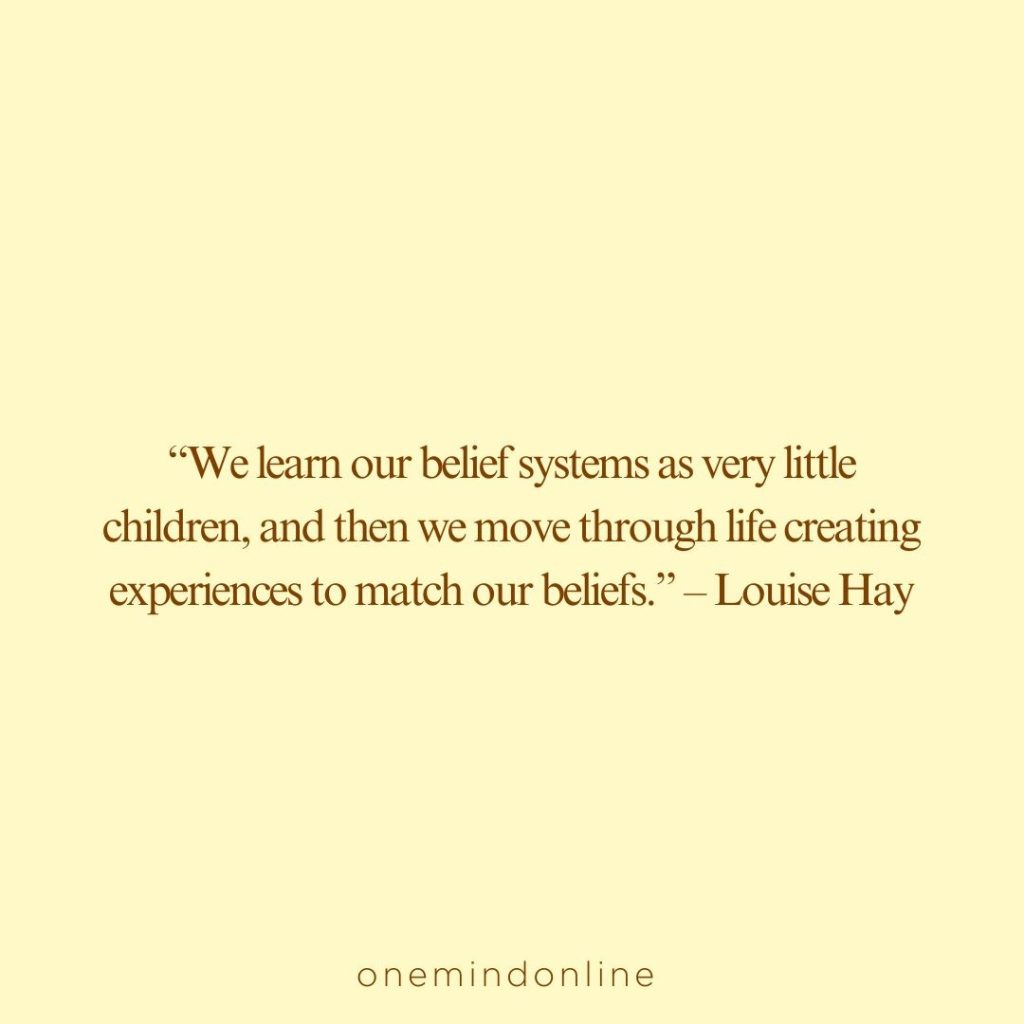
“We learn our belief systems as very little children, and then we move through life creating experiences to match our beliefs.” – Louise Hay
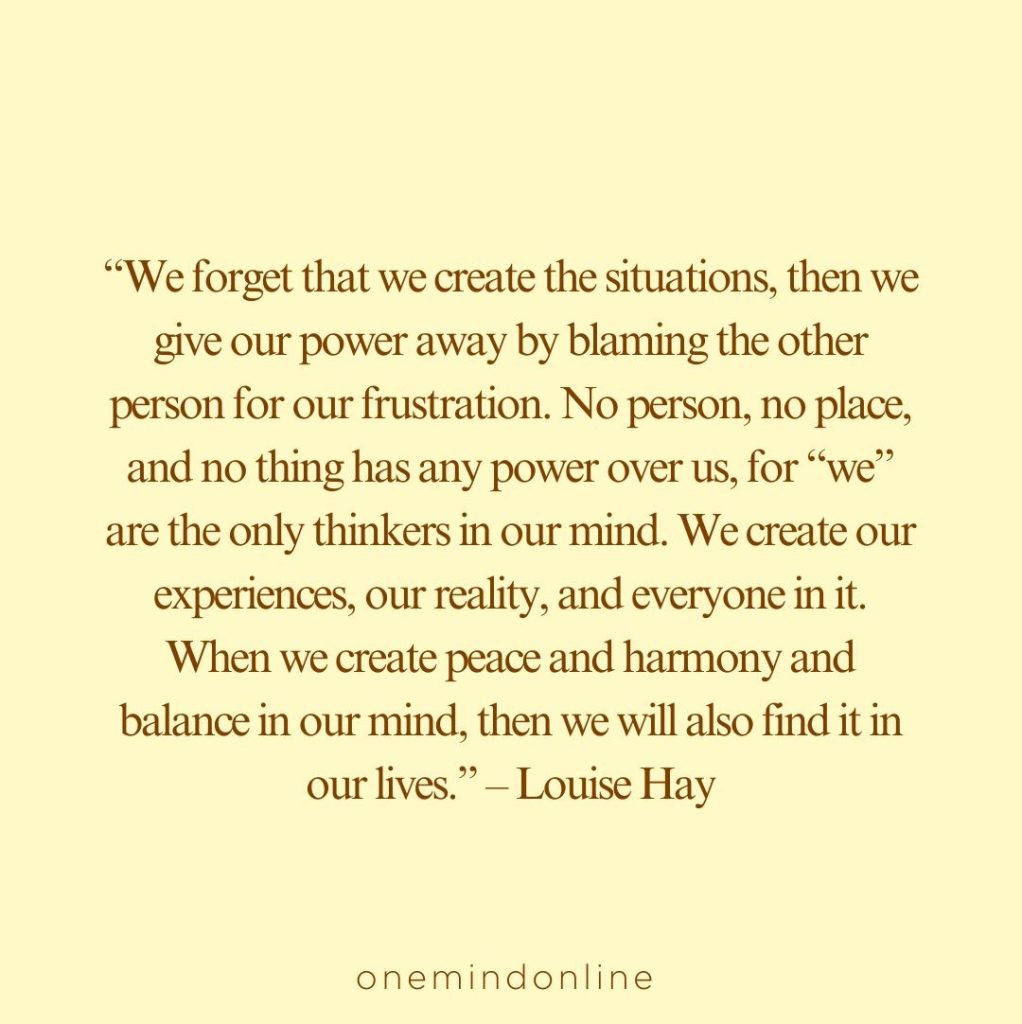
“We forget that we create the situations, then we give our power away by blaming the other person for our frustration. No person, no place, and no thing has any power over us, for “we” are the only thinkers in our mind. We create our experiences, our reality, and everyone in it. When we create peace and harmony and balance in our mind, then we will also find it in our lives.” – Louise Hay
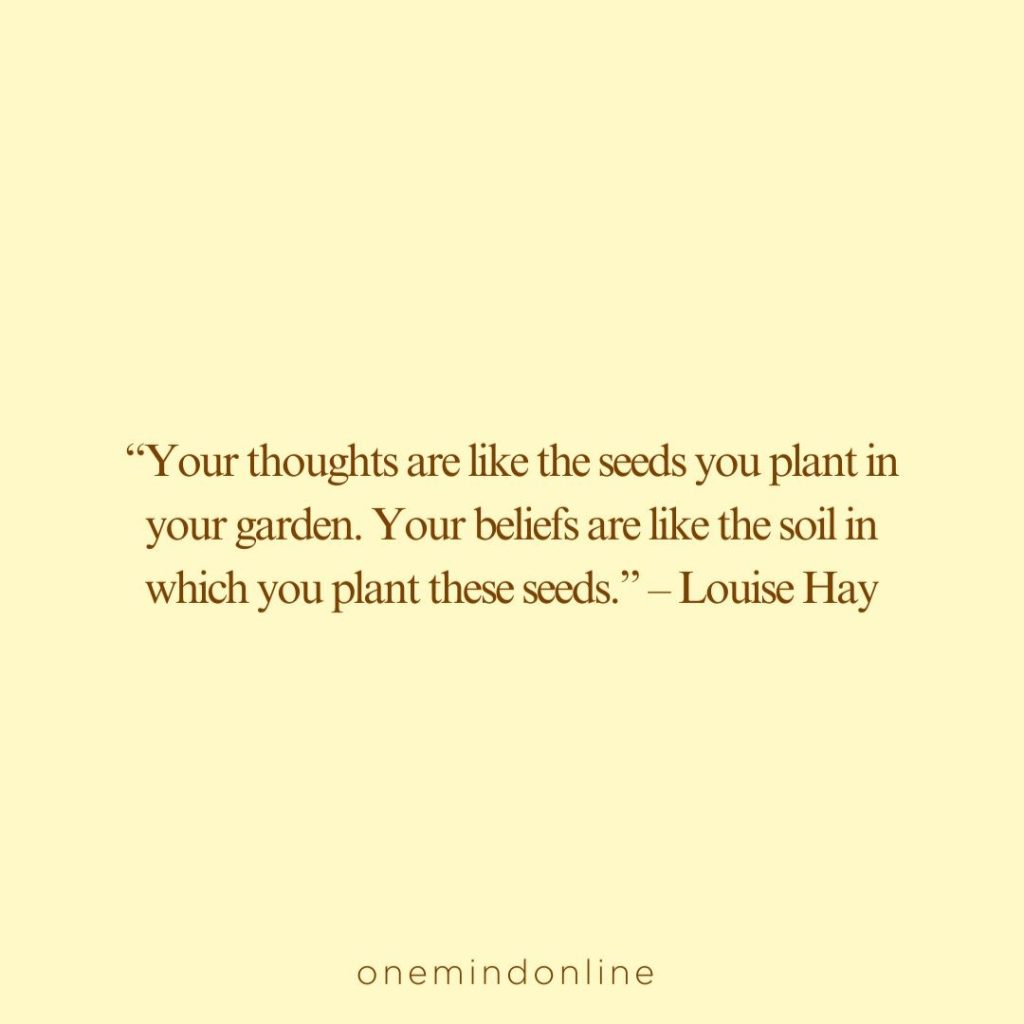
“Your thoughts are like the seeds you plant in your garden. Your beliefs are like the soil in which you plant these seeds.” – Louise Hay
The good news is this… you don’t have to remain stuck in the belief system you grew up with. You can trade in your old beliefs for a new set, and then your brain will go about its business as usual: highlighting from your environment all of the proof of your (new) beliefs.
The first step in breaking free from these limiting beliefs lies in becoming aware of what your thoughts and beliefs are. You have to become the observer of your thoughts, the witness to your thinking. Meditation is a powerful tool on this journey, cultivating introspection without judgement. By witnessing your thoughts, you will begin to identify the limiting beliefs that may be holding you back.
Once you’ve become aware of these beliefs, you can challenge them and replace them with more empowering alternatives. Remember, your thoughts are like seeds you plant in your garden. Your beliefs are the soil in which these seeds grow, and sometimes replacing the soil is exactly what your plants need.
Here are a few thoughts to help you on your journey:
- Observe your thoughts: Notice the thoughts that run through your mind without judging or fighting them.
- Challenge negative beliefs: Remind yourself that your view of yourself is mostly a recording of other people’s opinions. Ask yourself, “is this really true?”
- Cultivate self-compassion: Speak to yourself kindly in all circumstances.
- Practice mindfulness: Don’t get stuck in the past or the future, pour your energy into what you need to take care of in every present moment.
Remember, you do not have to be defined by your past. You have the power to create a new reality for yourself. By becoming aware of your beliefs and choosing to replace them with more empowering ones, you can break free from the chains of the past and unlock your full potential. You are the author of your own story. It’s time to write a new chapter.
– pierre –
Today’s LIVE meditation is: Finding silence.
Today’s LIVE meditation
https://youtu.be/cp27FCgS-B4 2025
https://youtu.be/VruhOuPms0U 2024
https://youtu.be/Lm4EeZv5Gto 2023
Practice the “Daily Dose”
Let’s put it into practice! Choose what works for you – daily, once a week or whenever inspiration strikes. Putting pen to paper wires the neural pathways that will create your new habits.
1 – Affirmation
In stead of affirmations, today brings you a few principles that may help you take a step back from old beliefs and cultivate a new perspective.
- Observe your thoughts: Notice the thoughts that run through your mind without judging or fighting them.
- Challenge negative beliefs: Remind yourself that your view of yourself is mostly a recording of other people’s opinions. Ask yourself, “is this really true?”
- Cultivate self-compassion: Speak to yourself kindly in all circumstances.
- Practice mindfulness: Don’t get stuck in the past or the future, pour your energy into what you need to take care of in every present moment.
2 – A moment of reflection
Use today’s question as a journal prompt. If you don’t have the time to sit down and write, just take a moment to reflect on your response.
Challenging Your Inner Truth: Choose one limiting belief about yourself that you’ve identified. Write it at the top of your page, then challenge it with these questions: “Is this really true? What evidence do I have that contradicts this belief? What would I tell a dear friend who held this same belief about themselves? If I were to plant new seeds in my mental garden, what empowering belief would I choose to replace this one with? What would my life look like if I truly believed this new, empowering truth about myself?”
3 – Quotes to share
Send a quote to someone who needs it, or share them all on social media to spread the good vibes!





4 – Q&A for deeper learning
Read through the questions and answers and write down at least one “aha moment” that clicked for you.
Q1: What exactly is a “mental recording” and how does it form?
A: Your mental recording is like a subconscious database of all the messages, experiences, and feedback you’ve received about yourself throughout your life. It forms primarily during childhood when your brain is most impressionable, but continues to be influenced by adult experiences. This recording contains the beliefs, assumptions, and “truths” about who you are, what you’re capable of, and what you deserve. Your subconscious treats this recording as fact because these experiences actually happened to you, even though the interpretations and meanings you assigned to them may not be accurate or helpful.
Q2: How can confirmation bias be both helpful and harmful?
A: Confirmation bias serves as a mental efficiency tool that helps your brain process the overwhelming 11 million bits of information it receives every second. This filtering system keeps us alive by quickly categorizing information based on existing beliefs. However, it becomes harmful when it locks us into limiting beliefs about ourselves. If you believe you’re not good enough, your brain will consistently highlight evidence that supports this belief while ignoring contradictory evidence. The key is becoming aware of this process so you can consciously choose which beliefs you want your brain to find evidence for.
Q3: Is it really possible to change deep-rooted beliefs formed in childhood?
A: Yes, absolutely. While childhood beliefs are deeply ingrained, your brain maintains neuroplasticity throughout your life, meaning it can form new neural pathways and connections. The first step is becoming aware of these beliefs through practices like meditation and mindful observation. Once you identify a limiting belief, you can challenge its validity and consciously choose to replace it with a more empowering alternative. Your brain will then begin seeking evidence for this new belief. The process requires patience and consistency, but transformation is entirely possible.
Q4: How do I know if my beliefs about myself are actually true or just learned patterns?
A: Most of our self-beliefs are learned patterns rather than objective truths. A helpful way to distinguish between the two is to ask yourself: “Is this really true?” and “What evidence do I have that contradicts this belief?” Consider whether you would tell a friend the same harsh things you tell yourself. Often, our most limiting beliefs stem from other people’s opinions, fears, or limitations that we internalized as children. Remember, just because someone treated you in a certain way doesn’t mean their treatment reflected your true worth or capabilities.
Q5: What role does meditation play in changing limiting beliefs?
A: Meditation is a powerful tool for belief transformation because it helps you become the observer of your thoughts rather than being controlled by them. Through regular meditation practice, you develop the ability to witness your thoughts without judgment, which is essential for identifying limiting beliefs. This awareness creates space between you and your thoughts, allowing you to recognize that you are not your thoughts—you are the consciousness observing them. This distinction is crucial for breaking free from limiting belief patterns and choosing new, empowering ones.
Q6: How long does it typically take to replace a limiting belief with an empowering one?
A: The timeline varies significantly depending on factors like how deeply ingrained the belief is, how consistently you practice new thinking patterns, and your commitment to the process. Some people notice shifts within weeks, while others may take months or even years for significant transformation. The key is consistency and patience. Your brain needs time to create new neural pathways and gather evidence for your new beliefs. Remember, you’re essentially rewiring decades of conditioning, so be compassionate with yourself throughout the process.
Q7: What are some practical daily practices for reinforcing new, empowering beliefs?
A: Start each day by observing your thoughts without judgment—notice what your mind gravitates toward. Challenge negative self-talk by asking “Is this really true?” and looking for evidence to the contrary. Practice self-compassion by speaking to yourself as you would a dear friend. Use affirmations that feel authentic to you, focusing on beliefs you want to strengthen. Practice mindfulness by staying present rather than dwelling on past failures or future fears. Finally, actively look for evidence that supports your new empowering beliefs—your brain will start to automatically highlight this evidence over time, creating a positive feedback loop that reinforces your growth.