

“Your Daily Dose” is a quick two minute read packed with bite-sized wisdom from all the great teachers. But you could also choose to turn it into something more… a powerful daily practice for personal growth. Give it a try!
A message from today’s meditation:
A trap we easily fall into when we’re trying to do better, to grow, to heal, is reaching for an “ideal” way of being or feeling, as a kind of proof of our progress. It’s easy to be disappointed by “negative” thoughts and feelings and read them as a step backwards in our attempt to grow, and in doing so, we can easily be caught in a cycle of self-rejection.
We experience a wide range of emotions – joy and sorrow, excitement and fear, anger and contentment. These emotions are not “good” or “bad”; they simply are. They are part of the human condition, a testament to our capacity to feel deeply and connect with the world around us.
“Meditation is not about feeling a certain way. It’s about feeling the way you feel.” – Dan Harris
When your arms are open to holding a space for every emotion that your body experiences, then in essence you are proving your own acceptance of YOU.
And when you have unconditional acceptance for your SELF, all feelings are held and released with a little more ease. Nothing gets stuck, because everything is allowed.
“Meditation is not about stopping thoughts, but recognizing that we are more than our thoughts and our feelings.” – Arianna Huffington
“Meditation is not spacing out or running away. In fact, it is being totally honest with ourselves” – Kathleen McDonald
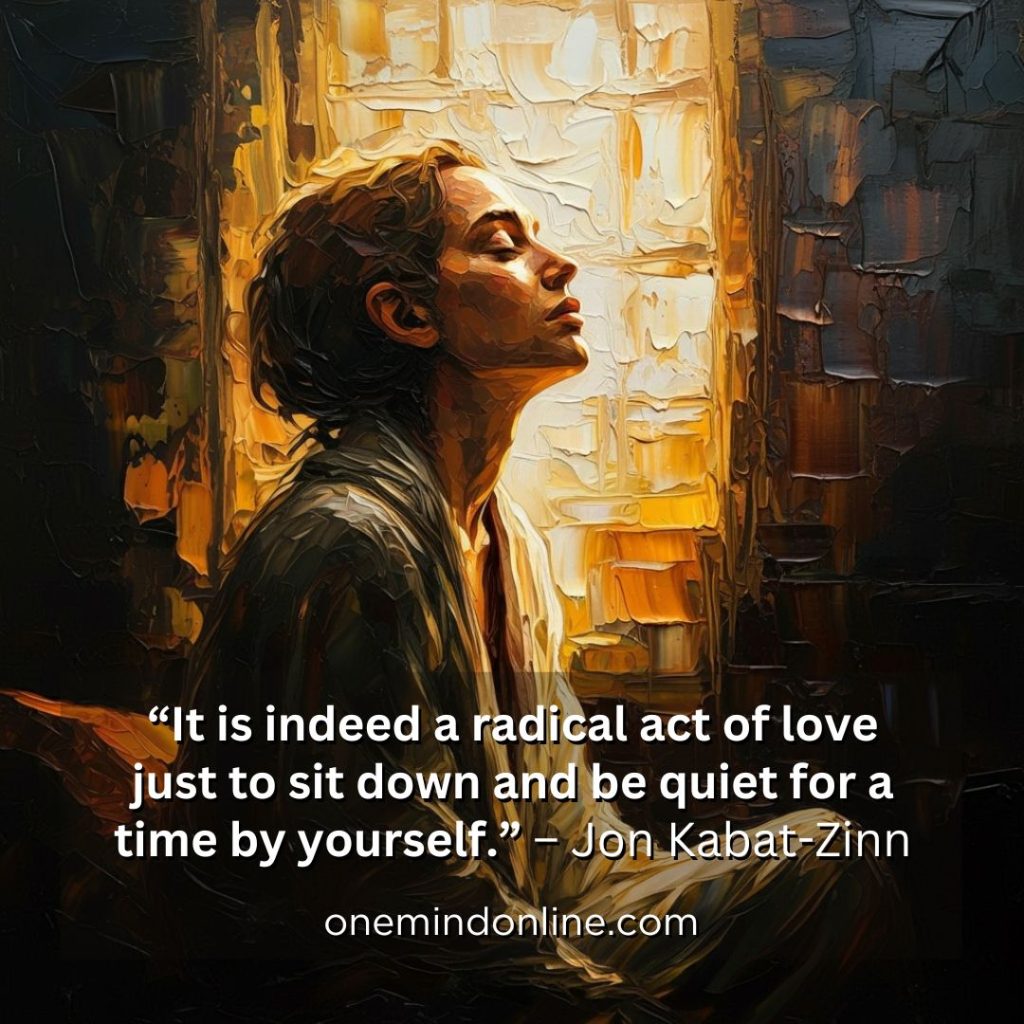
“It is indeed a radical act of love just to sit down and be quiet for a time by yourself” – Jon Kabat-Zinn
Just a note on this last thought by Kathleen McDonald about being honest with ourselves… this level of total honesty only becomes available in the presence of our own complete acceptance of our SELF. Without this level of self-acceptance, we’re never truly safe to be honest with ourselves.
Accepting every emotion, every thought, every sensation as valid and valuable is, in essence, accepting ourselves unconditionally. It is acknowledging that we are complex beings, capable of experiencing the full spectrum of human emotion. It is recognizing that our inner world is not always a pleasant place, and that’s okay.
So in the spirit of learning how to create acceptance for every thought and every emotion, our journey today is “Come to your senses” – a very simple and practical way to learn how to allow our body to feel whatever experience it is having.
A few affirmations for wholeness:
- “By learning to hold space for my thoughts and emotions, I discover that I am so much more than just these thoughts and emotions.”
- “I welcome all of my feelings without judgment, knowing they are part of being fully human.”
- “Every part of my experience deserves to be witnessed with compassion and understanding.”
In conclusion, self-acceptance is about recognizing the inherent worth and dignity of our human experience, with all its messiness and imperfection. The more acceptance you have for your human experience, the more freedom and joy you’ll find in being exactly who you are.
Enjoy your weekend!
– pierre –
Today’s LIVE meditation is: Come to your senses.
Today’s LIVE meditation
https://youtu.be/ZvbElqA9vcY 2025
https://youtu.be/vOVnUovcKOE 2024
https://youtu.be/VXZjRs-t2Bc 2022
Practice the “Daily Dose”
Let’s put it into practice! Choose what works for you – daily, once a week or whenever inspiration strikes. Putting pen to paper wires the neural pathways that will create your new habits.
1 – Affirmation
Write down your favourite affirmation on a sticky note and place it somewhere that you’ll be able to see it the whole day.
- “By learning to hold space for my thoughts and emotions, I discover that I am so much more than just these thoughts and emotions.”
- “I welcome all of my feelings without judgment, knowing they are part of being fully human.”
- “Every part of my experience deserves to be witnessed with compassion and understanding.”
2 – A moment of reflection
Use today’s question as a journal prompt. If you don’t have the time to sit down and write, just take a moment to reflect on your response.
Exploring Emotional Judgment: What emotions do I typically label as “bad” or “wrong”? How has judging these feelings affected my ability to process and release them? What might change if I viewed these emotions as simply part of being human rather than as evidence of failure?
3 – Quotes to share
Send a quote to someone who needs it, or share them all on social media to spread the good vibes!

4 – Q&A for deeper learning
Read through the questions and answers and write down at least one “aha moment” that clicked for you.
Q1: Doesn’t accepting all my emotions mean I’ll just stay stuck in negative patterns?
A: Actually, the opposite is true. When we resist or reject our emotions, they tend to persist and intensify. Acceptance creates the conditions for emotions to move through us naturally. By acknowledging and allowing our feelings without judgment, we prevent them from getting stuck. Acceptance doesn’t mean resignation—it means meeting our experience with honesty so we can respond skillfully rather than reactively.
Q2: How is self-acceptance different from self-improvement? Can I do both?
A: Self-acceptance and self-improvement aren’t mutually exclusive—they’re complementary. Self-acceptance means recognizing your inherent worth regardless of your circumstances or achievements. Self-improvement is about developing your potential. The key is growing from a foundation of self-acceptance rather than self-rejection. When you accept yourself unconditionally, growth comes from love rather than fear, making it more sustainable and fulfilling.
Q3: I’ve been meditating for months but still have anxious thoughts. Am I doing it wrong?
A: Not at all. As Dan Harris said, meditation isn’t about feeling a certain way—it’s about feeling the way you feel. Experiencing anxious thoughts doesn’t mean you’re failing; it means you’re human. The practice is about changing your relationship with those thoughts, observing them without judgment rather than trying to eliminate them. Over time, you’ll likely notice more space between you and your thoughts, even if the thoughts themselves haven’t disappeared.
Q4: What does it practically mean to “hold space” for my emotions?
A: Holding space for your emotions means allowing them to be present without trying to change, fix, or suppress them. It’s like being a compassionate witness to your own experience. Practically, this might involve noticing where you feel an emotion in your body, naming it (“this is anxiety,” “this is sadness”), and breathing with it rather than pushing it away. You’re creating an internal environment where all feelings are welcome guests, even the uncomfortable ones.
Q5: How can I be honest with myself if I’m afraid of what I’ll find?
A: This fear is exactly why self-acceptance must come first. Start small by acknowledging one thing you’ve been avoiding looking at, and meet it with compassion rather than judgment. Remember that self-honesty doesn’t mean harsh self-criticism—it means clear-eyed awareness combined with kindness. As you practice accepting smaller truths about yourself, you build the safety and courage needed to face deeper ones.
Q6: Isn’t unconditional self-acceptance just making excuses for bad behavior?
A: Self-acceptance doesn’t mean accepting harmful behavior—it means accepting your inherent worth as a person while still taking responsibility for your actions. You can acknowledge that you acted unskillfully without concluding that you’re fundamentally flawed. This distinction is crucial: accepting yourself unconditionally actually makes it easier to change problematic behaviors because you’re not working from a place of shame and self-rejection.
Q7: How long does it take to develop genuine self-acceptance?
A: Self-acceptance isn’t a destination you reach and then you’re done—it’s an ongoing practice. Some people experience breakthrough moments of self-acceptance, while for others it unfolds gradually over time. What matters most is consistency. Each time you meet a difficult emotion with acceptance rather than judgment, you strengthen this capacity. Be patient with yourself; developing unconditional self-acceptance is itself an act of self-acceptance.