

“Your Daily Dose” is a quick two minute read packed with bite-sized wisdom from all the great teachers. But you could also choose to turn it into something more… a powerful daily practice for personal growth. Give it a try!
A message from today’s meditation:
Is silence a skill we must develop? An art we must practice? Or is it simply the natural flow of being deeply content, no longer grasping for anything more?
Nicholas Sparks writes in The Notebook:
“We sit silently and watch the world around us. This has taken a lifetime to learn. It seems only the old are able to sit next to one another and not say anything and still feel content. The young, brash and impatient, must always break the silence. It is a waste, for silence is pure. Silence is holy. It draws people together because only those who are comfortable with each other can sit without speaking. This is the great paradox.” – Nicholas Sparks
Our resistance to silence (or otherwise put, our compulsion for distraction) is a symptom of an inner “tightness”. Old messaging that is convinced that something must be rushed toward, or something must be done right now, or something must be avoided at all cost. It’s easy to notice this inner resistance to stillness, just entertain the thought of sitting down for a meditation and notice the inner narratives rising to the surface in rebellion.
“Meditation provides a way of learning how to let go. As we sit, the self we’ve been trying to construct and make into a nice, neat little package continues to unravel.” – John Welwood
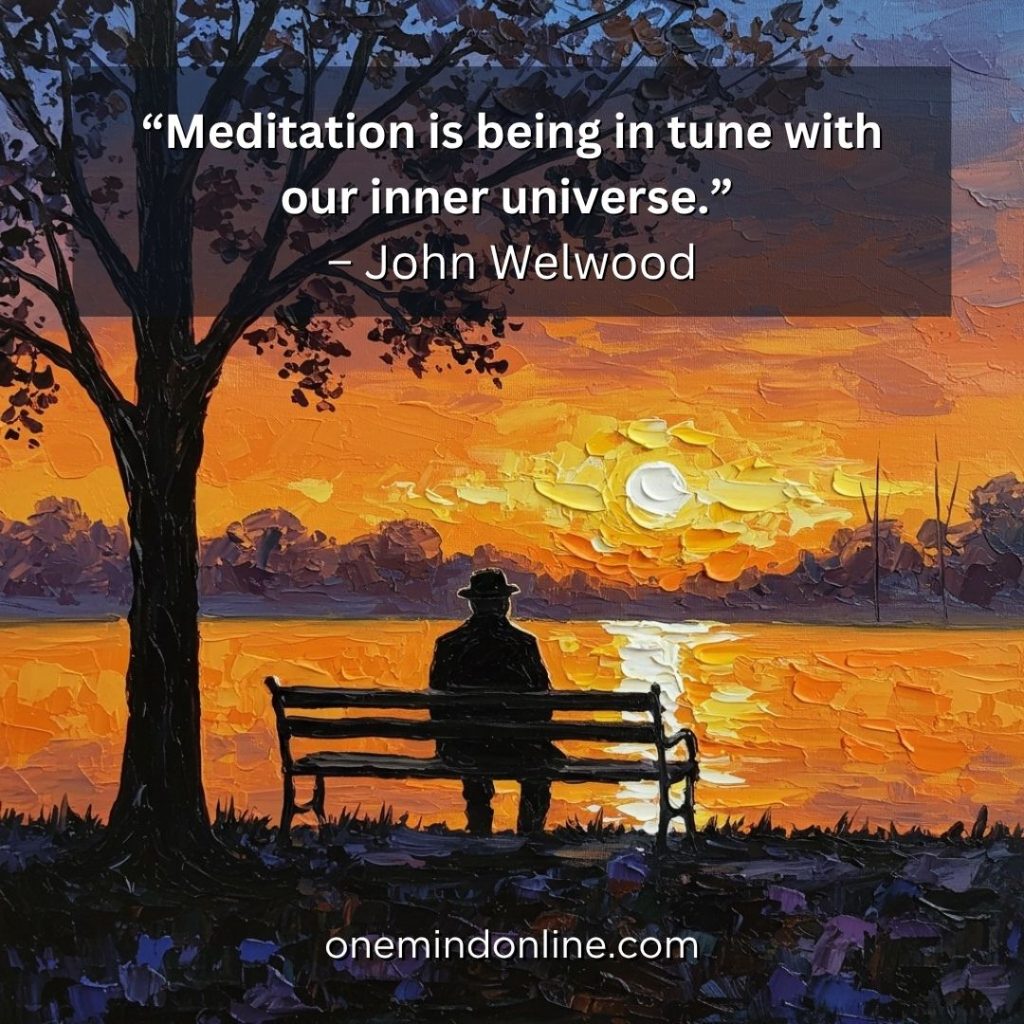
“Meditation is being in tune with our inner universe.” – John Welwood
Finding silence isn’t about retreating from the world or becoming a hermit on a mountaintop. It’s about discovering pockets of peace within the chaos of daily life. It’s about taking a mindful walk in nature, savoring the taste of a cup of tea without the compulsion to scroll through your phone, or simply closing your eyes for a few deep breaths between meetings.
In these moments of quietude, something remarkable happens. We reconnect with ourselves, and through that reconnection, we engage with the world around us with renewed purpose and clarity. Silence becomes not an escape but a homecoming.
Remember, silence is not the absence of sound, but the presence of peace – a space where true connection and self-discovery can blossom. So, take a deep breath, find a quiet corner, and embark on your own exploration of the art of silence.
So, how do we cultivate this art of silence? Here are a few mantras to guide you:
- Silence is not the absence of sound, but the presence of peace. Embrace the quiet moments, savor the stillness.
- Let go of the need to “do.” Be present in the moment, even if that moment is filled with nothing but the sound of your breath.
- Practice meditation. Start small, even five minutes a day. Observe your thoughts without judgment, and gently return your focus to your breath.
- Seek out nature. The natural world offers a symphony of calming sounds – birdsong, rustling leaves, the murmur of a stream.
- Become mindful of technology. Schedule “device-free” zones throughout your day to create pockets of silence.
May your journey be filled with moments of profound silence and the peace that it brings.
Wishing you a beautiful Sunday.
– pierre –
Today’s LIVE meditation is: Finding silence.
Today’s LIVE meditation
https://youtu.be/Zmoy1HaTQ7Q 2026
https://youtu.be/1mVxkxbHEmQ 2024
https://youtu.be/o5xtUfkRzuE 2022
Practice the “Daily Dose”
Let’s put it into practice! Choose what works for you – daily, once a week or whenever inspiration strikes. Putting pen to paper wires the neural pathways that will create your new habits.
1 – Affirmation
Write down your favourite affirmation on a sticky note and place it somewhere that you’ll be able to see it the whole day.
- Silence is not the absence of sound, but the presence of peace. Embrace the quiet moments, savor the stillness.
- Let go of the need to “do.” Be present in the moment, even if that moment is filled with nothing but the sound of your breath.
- Practice meditation. Start small, even five minutes a day. Observe your thoughts without judgment, and gently return your focus to your breath.
- Seek out nature. The natural world offers a symphony of calming sounds – birdsong, rustling leaves, the murmur of a stream.
- Become mindful of technology. Schedule “device-free” zones throughout your day to create pockets of silence.
2 – A moment of reflection
Use today’s question as a journal prompt. If you don’t have the time to sit down and write, just take a moment to reflect on your response.
Exploring Your Resistance: Sit quietly for just three minutes and observe what arises. What thoughts, feelings, or sensations emerge when you attempt to be still? What do these reactions reveal about what you might be avoiding or rushing toward in your life?
3 – Quotes to share
Send a quote to someone who needs it, or share them all on social media to spread the good vibes!


4 – Q&A for deeper learning
Read through the questions and answers and write down at least one “aha moment” that clicked for you.
Q1: Why is silence so uncomfortable for many people?
Silence can feel uncomfortable because it removes the distractions we use to avoid confronting our inner thoughts, feelings, and unresolved tensions. Our culture conditions us to equate busyness with productivity and worth, making stillness feel like wasted time. Additionally, silence allows suppressed emotions and uncomfortable truths to surface, which our psyche has been working hard to keep at bay through constant stimulation.
Q2: Is meditation the only way to cultivate silence?
Not at all. While meditation is a powerful practice, silence can be cultivated through many activities: mindful walking in nature, savoring a meal without distractions, engaging in creative activities with full presence, or simply taking a few conscious breaths between tasks. The key is intentionally creating moments of mental quietude within your daily routine, regardless of the specific activity.
Q3: How long does it take to become comfortable with silence?
As the article suggests, this may be a lifelong journey. However, you’ll likely notice small shifts within weeks of regular practice. Start with just five minutes of intentional silence daily and gradually increase. The goal isn’t to “master” silence quickly but to develop an ongoing relationship with stillness that deepens over time.
Q4: What’s the difference between silence and simply being alone?
Being alone doesn’t necessarily mean experiencing silence. You can be physically alone while mentally overwhelmed with distracting thoughts, scrolling social media, or multitasking. True silence involves both external quietude and internal stillness—a quality of presence and peace regardless of whether you’re alone or with others who are comfortable in shared silence.
Q5: Can you experience silence in a noisy environment?
Yes. External silence and inner silence are related but distinct. You can cultivate inner peace and stillness even in a busy environment by anchoring your attention in the present moment rather than being swept away by mental chatter. With practice, you can find an “eye of the storm” quality within yourself, even when external circumstances are chaotic.
Q6: How can I create more silence in my technology-dominated life?
Start by establishing clear boundaries: designate device-free times (like the first hour after waking or the last hour before bed), create phone-free zones (like the bedroom or dinner table), turn off non-essential notifications, and schedule regular “digital sabbaths.” The key is treating these boundaries as non-negotiable appointments with yourself, recognizing that your relationship with silence is as important as any other commitment on your calendar.