
Get ready to be inspired in just about the time it takes to brew a cup of tea (about 2 minutes)! And if you’ve got your feet up and that tea’s still hot, we’ve got a whole buffet of brilliance waiting for you on our menu.
A message from today’s meditation:
There’s a space between effort and surrender that can be a tricky piece of real estate to find. On the one side there is taking action, doing the work, getting stuff done, and it feels almost as if this is in direct opposition to the idea of taking a step back, letting go, having acceptance.
So which is the correct way to follow? The way of constant effort, or the path of least resistance?
Making a case for surrender:
The idea of surrender often receives instant resistance, especially when it brings up the image of fighting a just war against an evil oppressor. But for the moment, let’s apply this not to the image of war but only to your daily life right now… how many things are YOU fighting? And are all of these fights really worth it? Is every thing you’re trying to control really yours to control?
“Sometimes, it’s not the times we decide to fight, but the times we decide to surrender; that makes all the difference.” – Sissy Gavrilaki
“The moment of surrender is not when life is over. It’s when it begins.” – Marianne Williamson
But there is another truth here too, something that feels like it’s in opposition to the idea of surrender, and that is that nothing gets done without action.
Making a case for effort:
In his very simple way, Albert Einstein said, “nothing happens until something moves.” It’s clear that there are things that need to get done. Dishes won’t become clean unless we actually wash them, and if we don’t take out the trash, it will pile up inside.
“The only impossible journey is the one you never begin.” – Tony Robbins
Every journey can be navigated one step at a time, except for the journey where you never take the first step. Things only happen for us when we start to take action.
“When your clarity meets your conviction, and you apply action to the equation, your world will begin to transform before your eyes.” – Lisa Nichols
How do we balance these seemingly opposing forces?
Imagine for a moment a beautifully scenic road trip along the coast, the ocean to your left and an ever changing landscape to your right. Some parts of your journey are paved with straight and level tarmac, and other parts contain hairpin twists and turns cut into sheer cliff faces with the water far below.
For certain parts of this trip you’ll have your foot pressed down firmly on the accelerator, roaring down an extended stretch of road with the wind in your hair. But for other parts you’ll ease your foot off, slow things down because if you don’t, you’ll end up flying off a cliff.
Could it be that action and non-action are really not in opposition, but rather always part of the same journey?
“Life is a balance between what we can control and what we cannot. I am learning to live between effort and surrender.” – Danielle Orner
The wisdom to know the difference:
When do I put my foot down on the accelerator and when do I take it off? While I’m holding the wheel of my car in my hands this seems quite obvious, but while I’m steering my life, the straight highways or seaside mountain passes aren’t always so clearly distinguished from one another.
I have always loved the guidance of “The Serenity Prayer” in this question. Yes, we need to accept what we cannot change. And yes, we need to take action on what we can indeed change. But more than anything, what we are seeking is the wisdom to know the difference. Where do we find the wisdom?
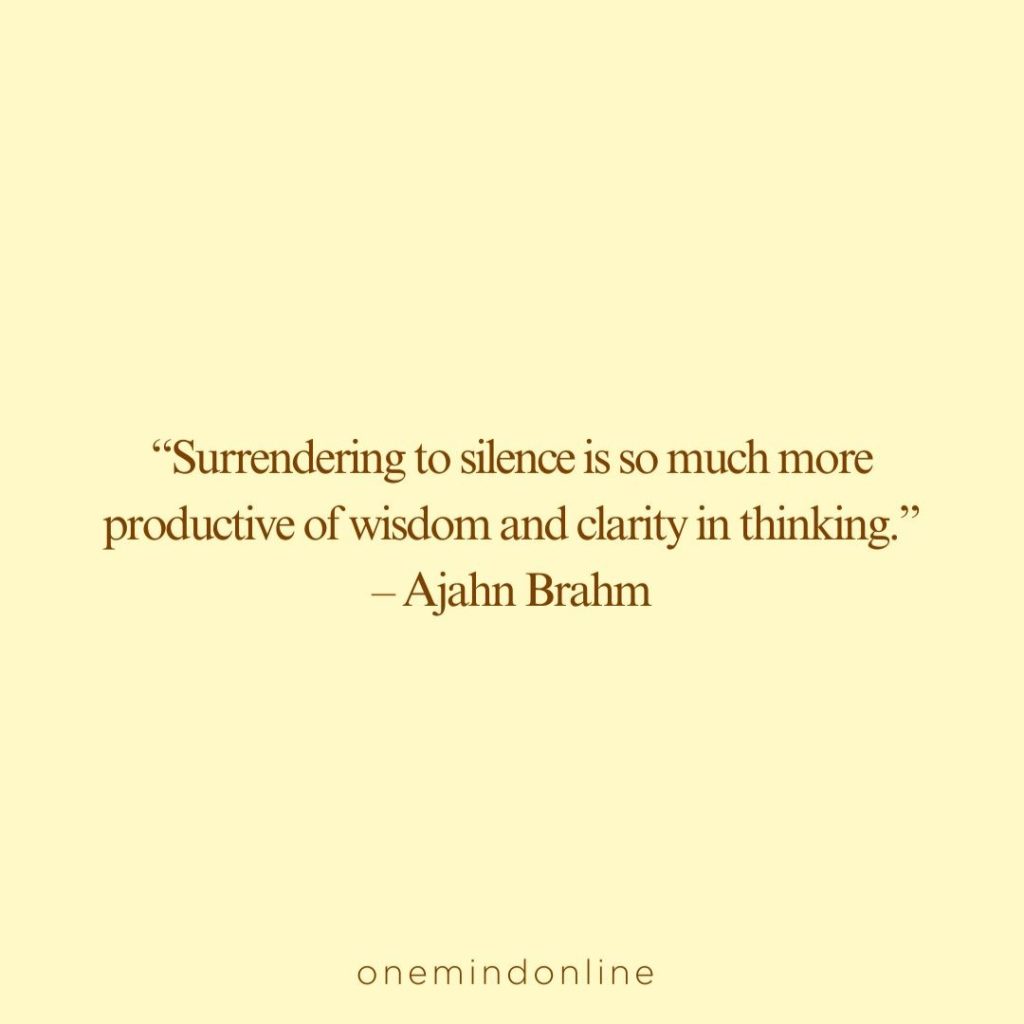
“Surrendering to silence is so much more productive of wisdom and clarity in thinking.” – Ajahn Brahm
Silence… stillness… brings us full circle to the balance between these seemingly opposing ideas of effort vs surrender.
When I surrender to silence, I get the opportunity to take a step back and really see: “what am I fighting that I should stop fighting? what am I trying to control that is not mine to control? where am I wasting energy that could be applied to acting in wisdom?”
True surrender allows the water to become calm, and calm water always becomes clear. True surrender always leads to clarity – and clarity always shows us where to take action.
Some questions for self-reflection:
- What am I fighting today that I can choose to surrender?
- Where am I wasting energy on control that isn’t mine to have?
- What action can I take today that aligns with true wisdom?
Join us for today’s meditation journey, a very practical experience of the serenity to accept the things that I cannot change, and the courage to change the things that I can.
– pierre –
Today’s LIVE meditation is: The serenity prayer.
A moment of reflection
(If you have the time, use this question as a journal prompt, because whenever you put pen to paper you’re wiring the neural pathways that create your new habits. But if you don’t have the time, just take a moment to reflect on your response.)
The Coastal Highway Reflection: Think of your life as that scenic coastal drive. Identify the “straight highway” areas where you can confidently accelerate—your strengths, clear goals, and areas of natural flow. Then identify the “hairpin turn” areas where you need to slow down—complex relationships, major transitions, or situations requiring more patience or even complete rest. Write about how you can better adjust your approach to match the terrain of each area of your life.
Today’s LIVE meditation
https://youtu.be/FG7KufQe-ZA 2024
https://youtu.be/nVcLvEG39mU 2022



Q&A for deeper learning
Q1: How do I know when I’m trying too hard versus not trying hard enough?
A: Pay attention to your energy levels and results. When you’re trying too hard, you often feel drained, frustrated, and see diminishing returns despite increased effort. When you’re not trying hard enough, you feel restless, unfulfilled, and notice opportunities passing by. The sweet spot feels like focused flow—engaged but not strained, persistent but not forcing.
Q2: Isn’t surrender just another word for giving up or being passive?
A: Not at all. Strategic surrender is an active choice to stop fighting battles you can’t win so you can redirect energy toward battles you can. It’s about discernment, not defeat. True surrender often requires more courage than fighting because it means letting go of the illusion of control.
Q3: How can I develop the “wisdom to know the difference” mentioned in the Serenity Prayer?
A: Wisdom develops through regular practice of stillness and self-reflection. Create daily moments of silence where you can step back from reactive thinking. Ask yourself consistently: “What am I trying to control that isn’t mine to control?” and “Where can I take meaningful action?” Over time, this practice sharpens your discernment.
Q4: What if I surrender something important and then regret it later?
A: True surrender isn’t permanent abandonment—it’s a strategic pause that creates space for clarity. You can always choose to re-engage with something from a place of wisdom rather than reactivity. Often, what we think we need to control urgently becomes less important when we step back and gain perspective.
Q5: How do I balance acceptance with the drive to improve and grow?
A: Acceptance doesn’t mean settling or stopping growth—it means accepting your current starting point without judgment while still moving toward your goals. You can fully accept where you are today while simultaneously taking steps toward where you want to be tomorrow. They’re complementary, not contradictory.
Q6: What’s the difference between healthy effort and forcing outcomes?
A: Healthy effort feels sustainable, aligned with your values, and produces steady progress even if slow. Forcing feels desperate, creates resistance, and often backfires. Healthy effort works with natural rhythms and opportunities; forcing tries to bulldoze through obstacles that might be signaling a need for a different approach.
Q7: How can I apply this balance in high-pressure situations like work deadlines or family crises?
A: Even in urgent situations, take micro-moments to pause and assess: “What parts of this situation can I actually influence?” Focus your energy there while accepting the elements beyond your control. This prevents panic and helps you respond more effectively. Sometimes the most productive thing you can do in a crisis is to stop, breathe, and gain clarity before acting.