

“Your Daily Dose” is a quick two minute read packed with bite-sized wisdom from all the great teachers. But you could also choose to turn it into something more… a powerful daily practice for personal growth. Give it a try!
A message from today’s meditation:
We stand at the beginning of a new week, a blank canvas waiting to be filled with the strokes of our choices and actions. Like a painter selecting their palette, we have the opportunity to choose the colors that will shape our experience.
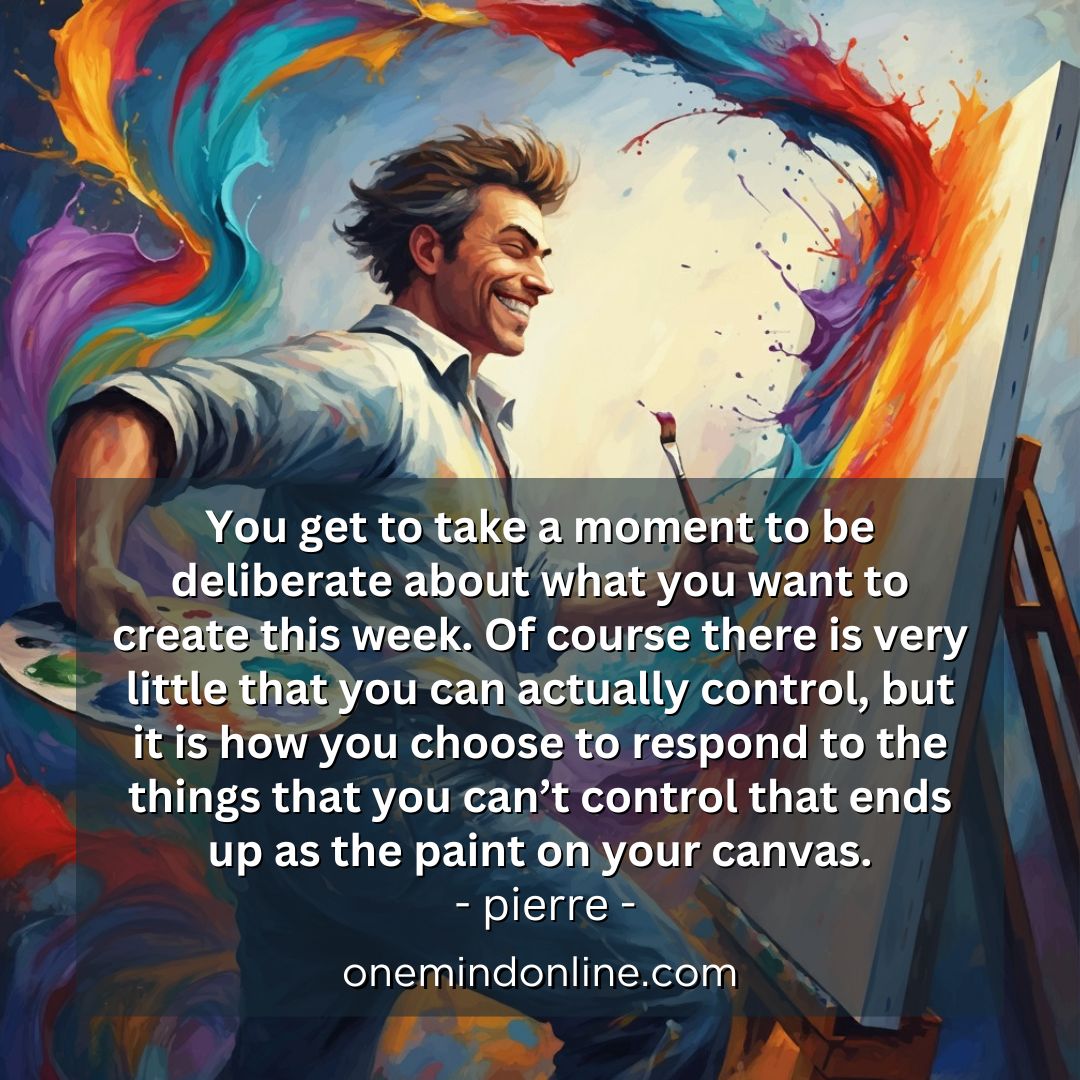
You get to take a moment to be deliberate about what you want to create this week. Of course there is very little that you can actually control, but it is how you choose to respond to the things that you can’t control that ends up as the paint on your canvas.
“With everything that has happened to you, you can either feel sorry for yourself or treat what has happened as a gift. Everything is either an opportunity to grow or an obstacle to keep you from growing. You get to choose.” – Wayne Dyer
“If you believe it will work out, you’ll see opportunities. If you believe it won’t you will see obstacles.” – Wayne Dyer
“If you change the way you look at things, the things you look at change.” – Wayne Dyer
Life WILL happen this week. Obstacles and stumbling blocks, and also opportunity will come your way. Think of every reaction and response you have to life this week as paint landing on your canvas, remind yourself that you are in control of how you apply your brush. A positive outlook can turn any situation into a masterpiece, while a negative one can reduce even the most promising canvas to a drab, lifeless image.
Take a moment to close your eyes for a few deep breaths and a little mental rehearsal of how you want to show up to this week. Be deliberate – right now – about deciding how you want to respond to the challenges that arise, then when they do, you’ll be prepared. And also…
Even with the BEST intentions sometimes you’ll fail, so rehearse a little kindness for yourself too. See yourself pick yourself up gently. See yourself dust yourself off lovingly. And see yourself try again persistently.
A few mantras to help shape your artistic expression this week:
- “I am the artist of my life.”
- “How I choose to see, shapes my reality.”
- “I choose to see the positive in every situation.”
- “I am kind to myself, even when I make mistakes.”
- “Every challenge is a canvas waiting to be painted.”
This week, let’s create a masterpiece together. Let’s paint our lives with vibrant colours, bold strokes, and a touch of magic. Let’s embrace challenges as opportunities, believe in our potential, and paint our canvas with the beauty of our souls.
Spread your wings, fly off into the week and create at your highest potential!
– pierre –
Today’s LIVE meditation is: Jumpstart the week.
Today’s LIVE meditation
https://youtu.be/GaLDzbfUHi4 2026
https://youtu.be/gk9C7Nbd8gc 2025
https://youtu.be/wkJWMe2ZG2g 2024
https://youtu.be/jvhsDW-hoPw 2023
https://youtu.be/gD8WCkCCzIo 2022
Practice the “Daily Dose”
Let’s put it into practice! Choose what works for you – daily, once a week or whenever inspiration strikes. Putting pen to paper wires the neural pathways that will create your new habits.
1 – Affirmation
Write down your favourite affirmation on a sticky note and place it somewhere that you’ll be able to see it the whole day.
- “I am the artist of my life.”
- “How I choose to see, shapes my reality.”
- “I choose to see the positive in every situation.”
- “I am kind to myself, even when I make mistakes.”
- “Every challenge is a canvas waiting to be painted.”
2 – A moment of reflection
Use today’s question as a journal prompt. If you don’t have the time to sit down and write, just take a moment to reflect on your response.
Self-Compassion as Creative Practice: Reflect on a recent mistake or moment when you didn’t respond to a situation as you would have liked. Now, imagine you are a master artist who has just made an unexpected mark on their canvas. How would a skilled artist respond? They might step back, assess the situation, and find a way to incorporate that “mistake” into something even more beautiful. How can you apply this same gentle, creative approach to your own imperfections? What would it look like to treat your mistakes as opportunities for innovation rather than reasons for self-criticism?
3 – Quotes to share
Send a quote to someone who needs it, or share them all on social media to spread the good vibes!
4 – Q&A for deeper learning
Read through the questions and answers and write down at least one “aha moment” that clicked for you.
Q1. What does it mean to be “the artist of your life”?
Being the artist of your life means recognizing that while you cannot control external events, you have complete authority over how you respond to them. Just as an artist chooses colours, brushstrokes, and techniques to create their vision, you choose your reactions, perspectives, and attitudes to create your life experience. Your responses to life’s challenges become the “paint” that ends up on your canvas, making you both the creator and the creation.
Q2. How can I actually change my perspective when I’m facing real difficulties?
Changing perspective doesn’t mean ignoring or minimizing real problems. Instead, it involves approaching challenges with curiosity rather than immediate judgment. Start by asking yourself: “What can this situation teach me?” or “How might this difficulty be redirecting me toward something better?” Practice mental rehearsal by visualizing yourself responding to challenges with calmness and creativity. Remember that perspective shift is a skill that develops over time with consistent practice.
Q3. What if I keep making the same mistakes despite my best intentions?
This is where self-compassion becomes crucial. Just as an artist doesn’t abandon a painting because of one imperfect brushstroke, you shouldn’t abandon your growth because of repeated mistakes. Each mistake is valuable data about your patterns and triggers. The key is to respond to your failures with the same patience and curiosity you’d show a dear friend. Pick yourself up gently, dust yourself off lovingly, and try again persistently – this is all part of the creative process.
Q4. How do I maintain a positive outlook when life feels overwhelming?
Maintaining positivity doesn’t mean forcing yourself to feel happy about difficult situations. Instead, it means choosing to look for opportunities within challenges and maintaining faith that you can handle whatever comes your way. Start small by finding one thing to appreciate each day, practice gratitude for your ability to grow through difficulties, and remember that every master artist has created their greatest works during their most challenging periods.
Q5. Can this “artist” approach really work for serious life challenges like job loss, illness, or relationship problems?
Absolutely. In fact, the most profound art often emerges from the deepest struggles. This approach doesn’t minimize serious challenges but rather empowers you to find meaning and growth within them. When facing major difficulties, the artistic mindset helps you ask: “How can I use this experience to develop strength, compassion, or wisdom?” Many people discover that their most difficult periods became the foundation for their most meaningful transformations.
Q6. How do I know if I’m making progress in becoming the “artist of my life”?
Progress often shows up in subtle ways: you might notice yourself pausing before reacting, finding lessons in setbacks more quickly, or treating yourself with greater kindness. You may find that situations that once triggered intense negative responses now feel more manageable. The quality of your mental and emotional “canvas” will gradually shift from reactive and chaotic to more intentional and harmonious. Trust that consistent practice of conscious responding is creating positive changes, even when they’re not immediately visible.
Q7. What’s the difference between being positive and being realistic?
Being the artist of your life isn’t about unrealistic optimism – it’s about realistic empowerment. You acknowledge difficulties honestly while simultaneously choosing to focus on what you can control: your response. A realistic artist knows that some paintings will be more challenging than others, that some days the light will be poor, and that mistakes are inevitable. But they also know that with skill, patience, and creativity, they can create something meaningful from any circumstances. This balance between honest assessment and empowered action is what makes the difference between toxic positivity and authentic resilience.