

“Your Daily Dose” is a quick two minute read packed with bite-sized wisdom from all the great teachers. But you could also choose to turn it into something more… a powerful daily practice for personal growth. Give it a try!
A message from today’s meditation:
Compassion or, the importance of having compassion is a familiar melody in personal growth circles. Even so, self-compassion seems to remain an under-developed skill. Not because we don’t try, but if our “shortcomings” were treated harshly while we grew up, then it’s likely that we struggle having acceptance for ourselves unless we’re being “perfect”.
“If your compassion does not include yourself, it is incomplete.” – Jack Kornfield
Today’s meditation is an exploration of SELF with the intent to see if we can find compassion for ourselves, even for the parts we don’t like.
“The emotional wisdom of the heart is simple. When we accept our human feelings, a remarkable transformation occurs. Tenderness and wisdom arise naturally and spontaneously. Where we once sought strength over others, now our strength becomes our own; where we once sought to defend ourselves, we laugh.” – Jack Kornfield
Most of us were taught that we are only acceptable when we display the “best” aspects of ourselves, that the moment we struggle or feel a bit low we are unacceptable.
“Ours is a society of denial that conditions us to protect ourselves from any direct difficulty and discomfort. We expend enormous energy denying our insecurity, fighting pain, death and loss and hiding from the basic truths of the natural world and of our own nature.” – Jack Kornfield
One of the basic truths of being human is that some days we’ll feel heavy and some days we’ll feel light. Some days we feel the darkness and other days we feel like light itself. How do we become better at navigating all of these “good” and “bad” feelings while continuing to become better at including ourselves in our circle of compassion?
Jack has simple and practical advice for how to open our arms to ourselves:
“As we willingly enter each place of fear, each place of deficiency and insecurity in ourselves, we will discover that its walls are made of untruths, of old images of ourselves, of ancient fears, of false ideas of what is pure and what is not.” – Jack Kornfield
This is how we’ll do it:
Not turning away from what scares us any more. No more numbing out. No more running away. Facing and accepting our own “pretty and also ugly” until we can look upon ourselves with kind eyes, appreciating just how hard this human has been trying.
When we have acceptance for our human feelings a remarkable transformation occurs, we gain access to the strongest part of our SELF. We step into the inner strength that is able to hold all of this. We are introduced to our soul.
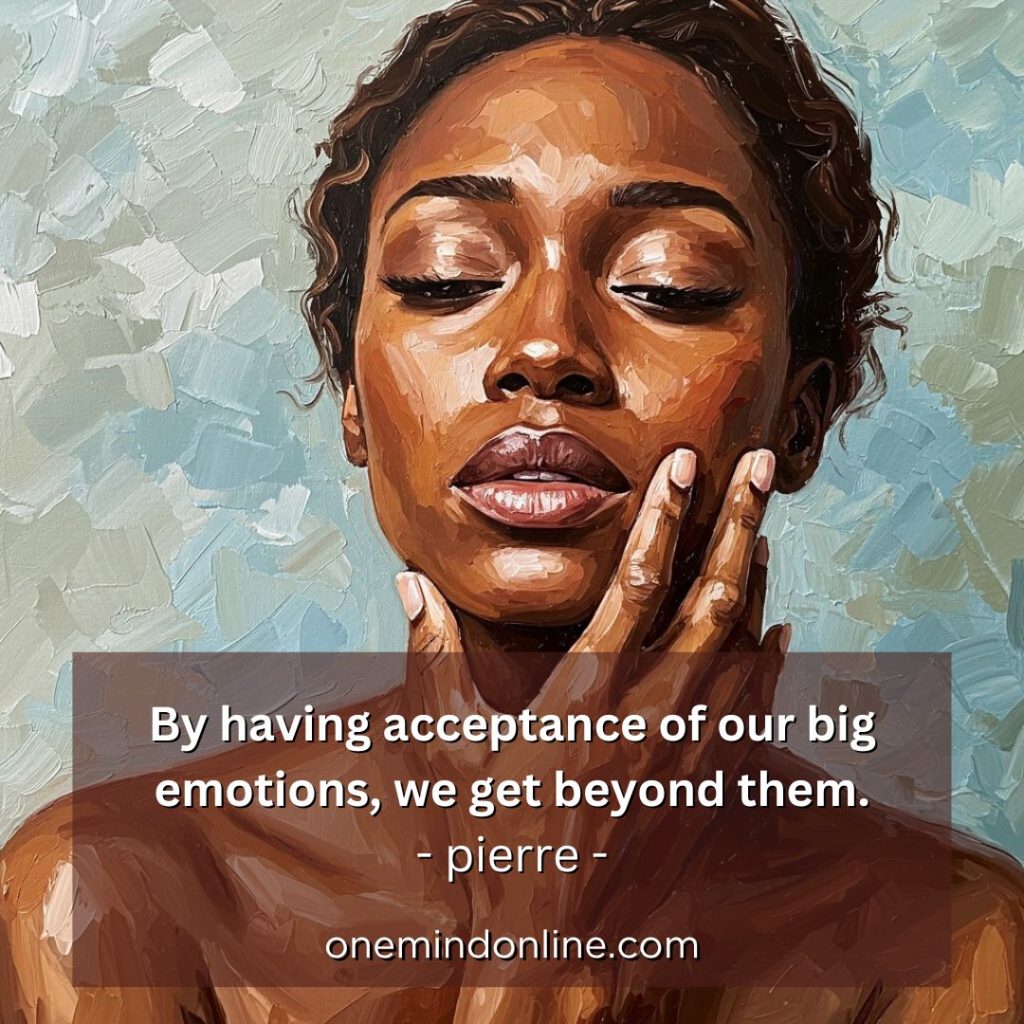
By having acceptance of our big emotions, we get beyond them.
Here are some guiding mantras for your journey of self-compassion:
- “I am worthy of love and acceptance, just as I am.”
- “All emotions are valid. I allow myself to feel them without judgment.”
- “I am on a lifelong journey of self-discovery. There will be stumbles, but I will extend compassion to myself throughout the process.”
- “I will cultivate patience and understanding towards my human imperfections.”
Join us for today’s meditation and see if you too can find a place in your heart for every part of you.
– pierre –
Today’s LIVE meditation is: A sense of self.
Today’s LIVE meditation
https://youtu.be/9qXC_XzjIVE 2026
https://youtu.be/N3uC1rc2Frg 2025
https://youtu.be/u7HT9yN-_OI 2024
https://youtu.be/zNwEOxl00-I 2023
https://youtu.be/vLlX0lziXJg 2022
Practice the “Daily Dose”
Let’s put it into practice! Choose what works for you – daily, once a week or whenever inspiration strikes. Putting pen to paper wires the neural pathways that will create your new habits.
1 – Affirmation
Write down your favourite affirmation on a sticky note and place it somewhere that you’ll be able to see it the whole day.
- “I am worthy of love and acceptance, just as I am.”
- “All emotions are valid. I allow myself to feel them without judgment.”
- “I am on a lifelong journey of self-discovery. There will be stumbles, but I will extend compassion to myself throughout the process.”
- “I will cultivate patience and understanding towards my human imperfections.”
2 – A moment of reflection
Use today’s question as a journal prompt. If you don’t have the time to sit down and write, just take a moment to reflect on your response.
Exploring Conditional Acceptance: Reflect on messages you received growing up about when you were “acceptable” versus “unacceptable.” What aspects of yourself did you learn to hide or reject? How do these early messages still influence how you treat yourself today?
3 – Quotes to share
Send a quote to someone who needs it, or share them all on social media to spread the good vibes!



4 – Q&A for deeper learning
Read through the questions and answers and write down at least one “aha moment” that clicked for you.
Q1. What does it mean that “if your compassion does not include yourself, it is incomplete”?
This means that true compassion isn’t selective—it must extend to everyone, including yourself. If you can feel compassion for others but are harsh and critical toward yourself, you’re practicing a limited form of compassion. Complete compassion recognizes that you, too, are deserving of kindness, understanding, and acceptance, especially during difficult times.
Q2. Why do so many people struggle with self-compassion even when they can easily show compassion to others?
This often stems from childhood conditioning. If our mistakes or struggles were met with harsh criticism while growing up, we internalize the belief that we’re only acceptable when we’re perfect. This creates an internal critic that’s far harsher than how we’d treat others. We’ve learned that self-compassion equals self-indulgence or making excuses, when actually it’s about honest acceptance of our humanity.
Q3. What is the “remarkable transformation” that occurs when we accept our human feelings?
When we stop fighting our emotions and accept them as valid parts of the human experience, we access deeper inner strength and wisdom. Instead of expending energy on denial and self-criticism, we develop genuine resilience. We move from defensiveness to openness, from seeking validation externally to finding strength within ourselves. This acceptance paradoxically helps us move through difficult emotions rather than staying stuck in them.
Q4. How does our culture contribute to the difficulty of practicing self-compassion?
Western culture, in particular, conditions us to avoid discomfort at all costs. We’re encouraged to fix, deny, or medicate away difficult feelings rather than face them. We’re taught that only positive emotions are acceptable and that struggle indicates failure. This cultural denial makes it extremely difficult to develop a healthy relationship with the full range of human experience, keeping us in patterns of avoidance and self-rejection.
Q5. What does it mean to “willingly enter each place of fear” in ourselves?
This means consciously choosing to face the parts of yourself you typically avoid—your insecurities, fears, perceived flaws, and difficult emotions—rather than numbing, distracting, or running from them. It’s about approaching these aspects with curiosity and openness, discovering that many of the “walls” around them are built from old, untrue stories rather than present reality.
Q6. Why does the article say we gain access to our soul through self-acceptance?
The “soul” here represents your deepest, most authentic self—the part of you that exists beyond roles, achievements, or external validation. When you’re constantly fighting and rejecting parts of yourself, you’re disconnected from this deeper essence. Self-acceptance allows you to experience your wholeness, including the inner strength that can hold all of your experiences without breaking. This is your soul: the witnessing presence that can embrace everything you are.
Q7. How can accepting difficult emotions help us “get beyond them”?
This seems counterintuitive, but resistance to emotions actually keeps them stuck in place. When you fight sadness, anxiety, or anger, you create a secondary layer of suffering around the original emotion. Acceptance doesn’t mean resignation or wallowing; it means acknowledging the emotion without judgment, which allows it to move through you naturally rather than getting trapped. Paradoxically, when you stop being at war with your emotions, you also stop being controlled by them.