

“Your Daily Dose” is a quick two minute read packed with bite-sized wisdom from all the great teachers. But you could also choose to turn it into something more… a powerful daily practice for personal growth. Give it a try!
A message from today’s meditation:
Do you ever feel like you’re always giving it everything you’ve got, while the world keeps throwing you unexpected curveballs? It can feel incredibly frustrating, leaving us questioning our efforts and wondering if we’re ever going to achieve the life we desire. But what if the true key to unlocking your best life lies not in controlling external outcomes, but in how you see and treat yourself?
Our teacher for this week is Debbie Ford, and her message for the start of your week is:
“The world responds to how you see yourself.”
“When you make peace with yourself, the world will mirror back that same level of peace.” – Debbie Ford
“The world mirrors yourself back to you. If you love, nourish, and appreciate yourself internally it will show up in your external life. If you want more love, give more love to yourself. If you want acceptance, accept yourself.” – Debbie Ford
“If you admire greatness in another human being, it is your own greatness you are seeing.” – Debbie Ford
“Live in the knowledge that you are a gift to the world.” – Debbie Ford
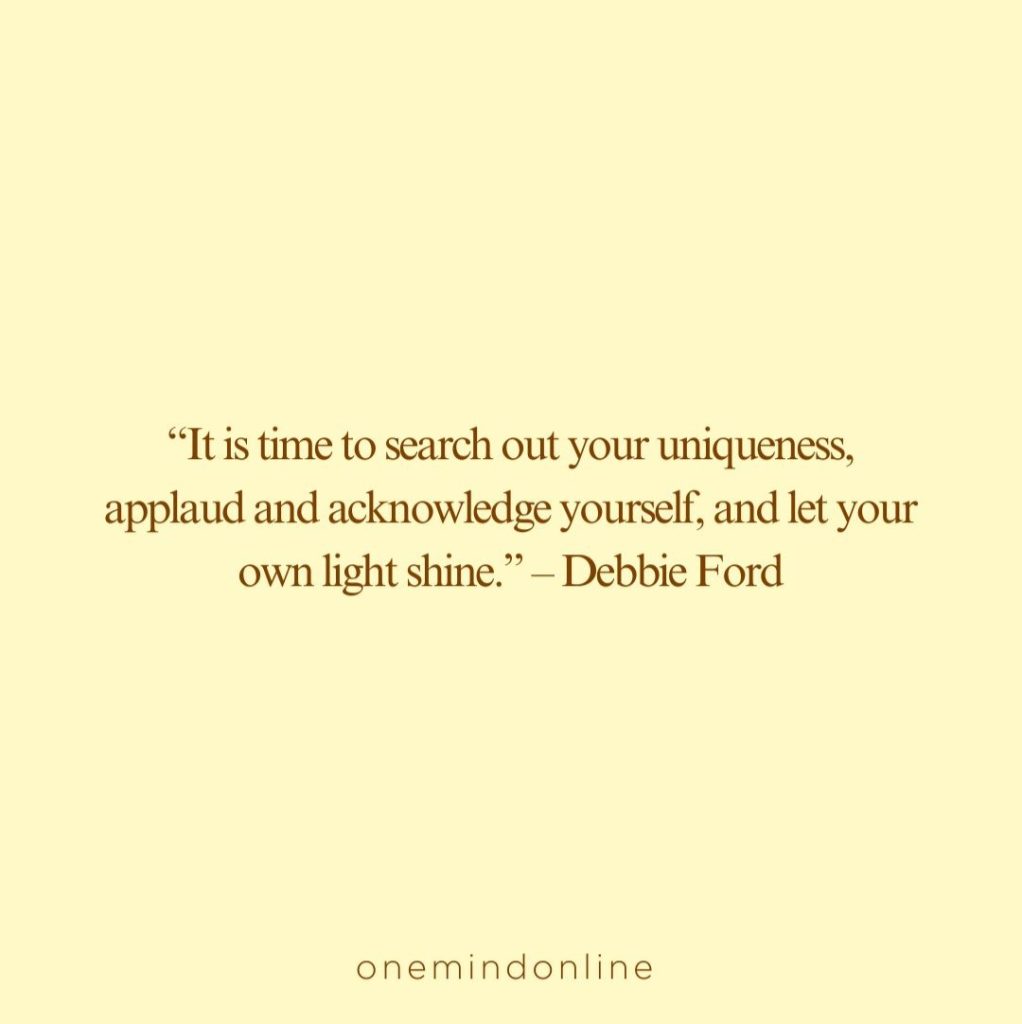
“It is time to search out your uniqueness, applaud and acknowledge yourself, and let your own light shine.” – Debbie Ford
Just to reiterate the message from Debbie Ford for you this week – how you see yourself gets mirrored back to you from the world around you. So…
… how do you see yourself?
When you look at yourself – what do you see?
How do you feel about what you see?
How do you talk to yourself…?
How you talk to yourself is the most intimate conversation you’ll ever have with anyone in the world! So you can just as well pay attention to getting better at this conversation.
I’d like to suggest a simple daily exercise for you this week: Every day for this next week, when you put yourself to bed take a minute to talk to yourself and remind yourself that you’re doing your best.
I know you’re doing your best and trying your hardest, and I’m here to tell you that it’s enough. But the truth however is that even when we do our best, it’s no guarantee that things will turn out the way we want them to. We can give our full 100% and still not realize the goals we set and what then…?
When our plans don’t work out we have a simple choice: we can stop doing our best, or we can get up tomorrow morning and do our best again! In this I always feel guided by a piece of wisdom I heard a long time ago, “The true master always has clear intent, and also accepts whatever happens as the perfect outcome.”
Can I do my best today, and when I go to bed tonight accept that however the day turned out was perfect? Can I create and surrender… create and surrender, like taking a deep breath in… and then also letting it go… create and let go… create and let go…
The best writing on “doing your best” I have ever come across is by Don Miguel Ruiz in the book “The Four Agreements” and here’s just a little taste for you:
“Always Do Your Best. But understand that your best is going to change from moment to moment; it will be different when you are healthy as opposed to sick. Under any circumstance, simply do your best, and you will avoid self-judgment, self-abuse and regret.” – Miguel Ruiz
So tonight when you put yourself to bed – and also every other night this week – take a moment to check in with yourself and remind yourself, “you are indeed doing your best, and tomorrow you will try again.”
Here are some mantras to guide you in the week ahead:
- “The world responds to how I see myself.”
- “My best is enough, always.”
- “My challenges are opportunities for growth.”
- “I trust my journey and celebrate my progress.”
Join today’s meditation to master the art of self-talk and mirror your magic into the world! Let’s shine together!
– pierre –
Today’s LIVE meditation is: Jumpstart the week!
Today’s LIVE meditation
https://youtu.be/oIoKn0Q0IqU 2026
https://youtu.be/ht5J2cz6XdM 2025
https://youtu.be/m5HVR1Dnc0E 2024
https://youtu.be/MbYmgpTVZsU 2023
Practice the “Daily Dose”
Let’s put it into practice! Choose what works for you – daily, once a week or whenever inspiration strikes. Putting pen to paper wires the neural pathways that will create your new habits.
1 – Affirmation
Write down your favourite affirmation on a sticky note and place it somewhere that you’ll be able to see it the whole day.
- “The world responds to how I see myself.”
- “My best is enough, always.”
- “My challenges are opportunities for growth.”
- “I trust my journey and celebrate my progress.”
2 – A moment of reflection
Use today’s question as a journal prompt. If you don’t have the time to sit down and write, just take a moment to reflect on your response.
Finding Greatness in Others and Yourself: Think about someone you deeply admire. What specific qualities draw your admiration? Now sit with this challenging question: how might these qualities already exist within you, perhaps unexpressed or unacknowledged? What would it look like to let your own light shine in this way?
3 – Quotes to share
Send a quote to someone who needs it, or share them all on social media to spread the good vibes!




4 – Q&A for deeper learning
Read through the questions and answers and write down at least one “aha moment” that clicked for you.
Q1: What does it mean that “the world responds to how you see yourself”?
This principle suggests that your external reality often mirrors your internal state. Neuroscience is very clear on this, this is a fundamental principle of survival, that your brain’s job is to reinforce whatever you already believe. When I expect the people I encounter to be friendly and helpful, my brain’s job is to find and point out to me all the friendly and helpful people. And my brain will construct a story about these friendly and helpful people to reinforce what I already believe. But… when I expect the people I encounter to be hostile and unhelpful, my brain’s job is to find and point out to me all the hostile and unhelpful people. And my brain will construct a story about these hostile and unhelpful people to reinforce what I already believe. And what’s more, I will vehemently defend my position by pointing out exactly where they’re being hostile and unhelpful, so that my own hostile an unhelpful reaction ensures that I keep getting hostility and unhelpfulness in return.
Q2: How can my best be “enough” when I’m not achieving my goals?
There is more to achieving a goal than just our own personal effort. Often, for a goal to come to fruition a number of external factors need to come together as well and as we well know, we can only control our own effort. Think of the example of an archer…. the archer can put all his effort into practicing drawing, aiming and firing arrows every day but as soon as he let’s the arrow go, he has zero control over the wind or whether the target moves. Doing your best requires that you don’t give up when an arrow misses, but keep showing up to draw, aim and fire arrows while you see your accuracy improve over time. You can honor your effort while also learning, adjusting, and trying again. Success isn’t just about outcomes—it’s also about the consistency you’re showing up with.
Q3: Why does “doing your best” change from moment to moment?
Your capacity is always going to vary based on countless factors: physical health, emotional state, energy levels, resources available, and external circumstances. Your best when you’re well-rested and healthy looks different from your best when you’re sick or exhausted. Recognizing this prevents the harmful trap of holding yourself to an impossible standard and instead encourages self-compassion.
Q4: What’s the practical benefit of the bedtime self-talk exercise?
This nightly practice helps you end each day with self-compassion rather than criticism. It interrupts patterns of negative self-talk, reduces anxiety about tomorrow, and helps you process the day without harsh judgment. Over time, this practice rewires your relationship with yourself, making your inner dialogue more supportive and empowering, increasing your ability to keep showing up even when you’ve missed a few arrows.
Q5: How do I “create and surrender” at the same time? Aren’t they opposites?
Creating and surrendering aren’t opposites but complementary practices in the same cycle of creation. Creating means setting intentions, making plans, and taking action with purpose. Surrendering means releasing attachment to specific outcomes and accepting whatever unfolds. You can work with full commitment while simultaneously holding your goals lightly. This balance prevents both passivity and the suffering that comes from rigid control.
Q6: What if I look at someone I admire and genuinely don’t see those qualities in myself?
This is common, but Ford’s insight is that you couldn’t recognize or appreciate a quality in someone else if you didn’t have at least the seed of it within yourself. Those qualities might be dormant, underdeveloped, or expressed differently in your life, but the very fact that you recognize and value them indicates they resonate with something inside you. The work is in acknowledging and developing those seeds.
Q7: How do I start changing negative self-talk if it’s been my pattern for years?
Start small and consistent. Begin with the suggested practice of one kind statement to yourself each night before bed. Notice when you’re being self-critical and gently redirect, the way you might speak to a good friend. Don’t expect perfection—changing lifelong patterns takes time. The goal isn’t to eliminate all negative thoughts but to build a more balanced, compassionate inner voice alongside them. Progress, not perfection, is what matters.