

“Your Daily Dose” is a quick two minute read packed with bite-sized wisdom from all the great teachers. But you could also choose to turn it into something more… a powerful daily practice for personal growth. Give it a try!
A message from today’s meditation:
We often navigate our lives through a lens of judgement, quick to categorize people into boxes of “good” or “bad”, “heroes vs villains.” But this binary thinking blinds us to a profound truth that could transform every interaction we have: the beautiful, messy complexity of being human.
Consider for a moment the faces you pass each day – the colleague who snapped at you, the stranger who cut you off in traffic, the family member whose words stung. Behind each reaction lies a story of wounds, some fresh and bleeding, others old but never fully healed. The wisdom traditions have long understood what modern psychology now confirms: people don’t just act – they react, and most often, they are reacting from old wounds that we are not even aware of in the moment.
Today’s meditation takes a look at the humans around us with a reminder –
You know what it feels like to be in survival mode right? To have periods in your life when fear is the dominant state that you experience, everything feels scary and you just don’t see how it gets better?
When you look at the humans around you and their behaviour please remember, most people are constantly experiencing their own version of survival mode.
“This is my simple religion. There is no need for temples; no need for complicated philosophy. Our own brain, our own heart is our temple; the philosophy is kindness.” – Dalai Lama
“The planet does not need more successful people. The planet desperately needs more peacemakers, healers, restorers, storytellers, and lovers of all kinds.” – Dalai Lama
“Whether one is rich or poor, educated or illiterate, religious or non-believing, man or woman, black, white, or brown, we are all the same. Physically, emotionally, and mentally, we are all equal. We all share basic needs for food, shelter, safety, and love. We all aspire to happiness and we all shun suffering. Each of us has hopes, worries, fears, and dreams. Each of us wants the best for our family and loved ones. We all experience pain when we suffer loss and joy when we achieve what we seek. On this fundamental level, religion, ethnicity, culture, and language make no difference.” – Dalai Lama
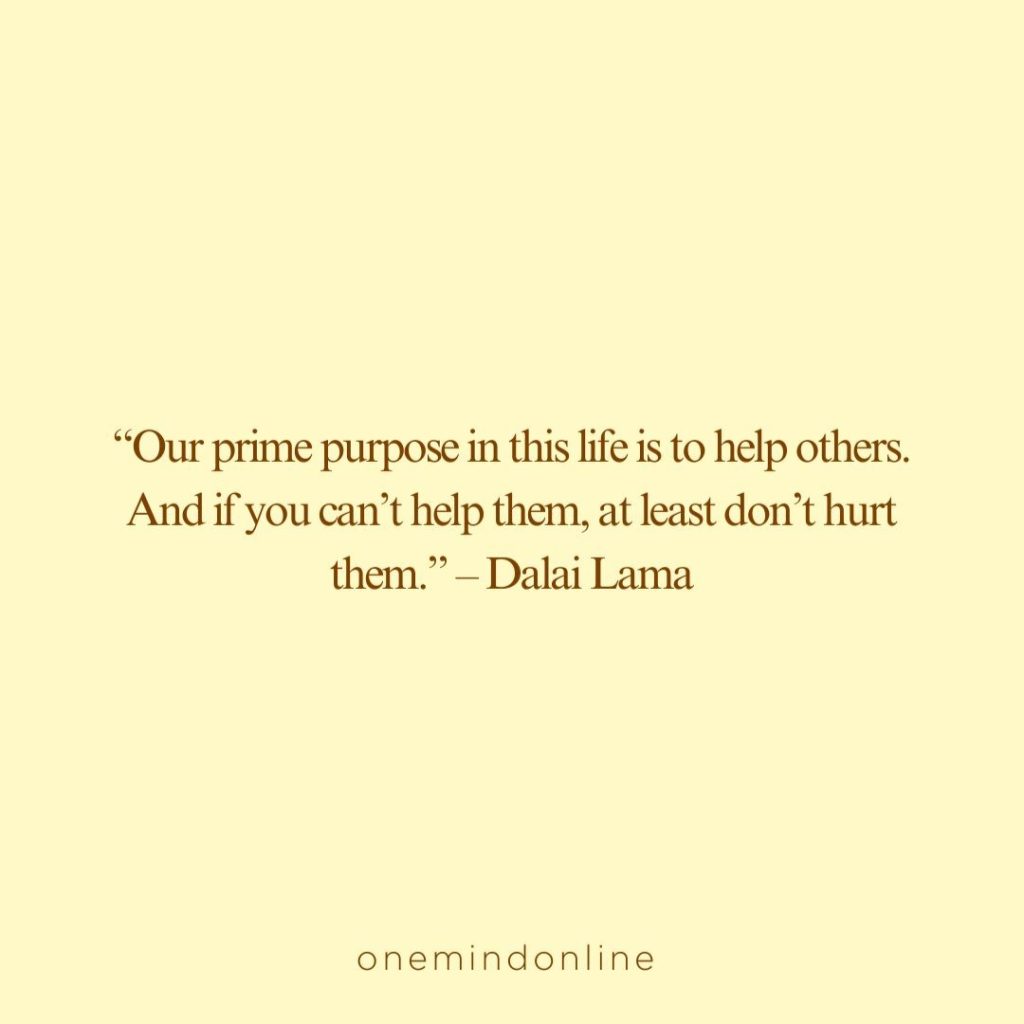
“Our prime purpose in this life is to help others. And if you can’t help them, at least don’t hurt them.” – Dalai Lama
“As you breathe in, cherish yourself. As you breathe out, cherish all Beings.” – Dalai Lama
“Be kind whenever possible. It is always possible.” – Dalai Lama
To truly connect with others, we must acknowledge the wounds that shape their actions. When we see someone acting out of fear or anger, we can remember our own moments of vulnerability. Perhaps they are reacting to a past trauma, a current challenge, or a deep-seated insecurity. By recognizing their pain, we can respond with kindness and understanding rather than judgement and condemnation.
Understanding that for the most part the humans around us are reacting from their own wounding and in need of healing, doesn’t mean that we discard our own boundaries though. But even our boundaries can inflict damage when we enforce them in ignorance and not in understanding.
Mantra for self-reflection:
- “I recognize that others’ reactions often stem from wounds I cannot see.”
- “I can hold firm boundaries while maintaining compassion for those around me.”
- “My past survival modes help me understand the struggles of others.”
- “I choose to respond with understanding rather than judgment, even when it’s difficult.”
- “I am both worthy of protection and capable of extending grace.”
It’s important to note that embracing empathy doesn’t mean we should tolerate abusive or harmful behaviour. Rather, it means that we should strive to respond with kindness and understanding, even in the face of provocation. We can set boundaries and protect ourselves while choosing compassion over judgement
Thank you for being a source of light in the world around you.
– pierre –
Today’s LIVE meditation is: Tonglen.
Today’s LIVE meditation
https://youtu.be/JVsZCDlbMbI 2025
https://youtu.be/uF5TGwDv2-Q 2024
https://youtu.be/eBkGaQ4Zbhs 2023
https://youtu.be/KXH0j6OSl34 2022
Practice the “Daily Dose”
Let’s put it into practice! Choose what works for you – daily, once a week or whenever inspiration strikes. Putting pen to paper wires the neural pathways that will create your new habits.
1 – Affirmation
Write down your favourite affirmation on a sticky note and place it somewhere that you’ll be able to see it the whole day.
- “I recognize that others’ reactions often stem from wounds I cannot see.”
- “I can hold firm boundaries while maintaining compassion for those around me.”
- “My past survival modes help me understand the struggles of others.”
- “I choose to respond with understanding rather than judgment, even when it’s difficult.”
- “I am both worthy of protection and capable of extending grace.”
2 – A moment of reflection
Use today’s question as a journal prompt. If you don’t have the time to sit down and write, just take a moment to reflect on your response.
Examine your boundaries through the lens of compassion: Write about a boundary you’ve set or need to set. How can you maintain this boundary firmly while still acknowledging the humanity of the other person? What’s the difference between a boundary enforced with understanding versus one enforced in ignorance? What would it look like to protect yourself without making someone else wrong?
3 – Quotes to share
Send a quote to someone who needs it, or share them all on social media to spread the good vibes!




4 – Q&A for deeper learning
Read through the questions and answers and write down at least one “aha moment” that clicked for you.
Q1: Doesn’t understanding why someone hurt me mean I have to let them continue hurting me?
A: Absolutely not. Understanding that someone’s harmful behavior stems from their own wounds doesn’t require you to tolerate abuse. You can hold compassion for their pain while firmly protecting yourself from their actions. Boundaries enforced with understanding simply mean you set limits without dehumanizing the other person—you can say “this behavior is unacceptable and I’m removing myself from it” without declaring them irredeemably evil.
Q2: How do I balance empathy for others with taking care of my own mental health?
A: Empathy doesn’t mean absorbing everyone’s pain or sacrificing your wellbeing. The tonglen practice—”as you breathe in, cherish yourself; as you breathe out, cherish all beings”—illustrates this balance beautifully. Self-care and compassion for others aren’t opposing forces. In fact, you can only sustainably offer understanding to others when you’re also healing and protecting yourself. Think of it like airplane oxygen masks: secure your own first, then help others.
Q3: What if I’ve tried to be understanding but the person keeps hurting me? At what point is compassion just enabling bad behavior?
A: Compassion never requires you to remain in harmful situations. There’s a crucial difference between understanding why someone behaves the way they do and accepting that behavior as okay. You can recognize that someone is acting from their wounds while also recognizing that you cannot heal those wounds for them and that staying in proximity to their unhealed pain is damaging you. Walking away from someone, even permanently, can be done with compassion—for them and especially for yourself.
Q4: I struggle with judgment because some people really do behave badly. How is it helpful to make excuses for them?
A: Understanding isn’t making excuses—it’s seeing the full picture. Someone can be both wounded and responsible for their actions. Recognizing that people often react from survival mode doesn’t absolve them of accountability; it simply helps you respond more effectively. When you understand the fear or pain driving someone’s behavior, you’re less likely to escalate conflict and more likely to either set effective boundaries or find paths toward resolution. This protects your peace while maintaining your integrity.
Q5: How can I tell the difference between someone genuinely struggling and someone manipulating me with their “wounds”?
A: This is where boundaries become essential. Pay attention to patterns, not explanations. Someone genuinely working through their wounds will show some capacity for self-reflection, accountability, and change over time, even if progress is slow. Manipulators use their past as a permanent excuse with no intention of growth. Trust your instinct when something feels off. Compassionate understanding doesn’t mean being naive—you can hold space for someone’s pain while still noticing if they’re weaponizing it.
Q6: What does it mean to enforce boundaries “in understanding” versus “in ignorance”?
A: A boundary enforced in ignorance comes from pure judgment: “You’re a terrible person, so I’m cutting you off.” A boundary enforced in understanding acknowledges complexity: “I recognize you’re struggling, and I have compassion for your pain, but I cannot allow this behavior to continue affecting me.” The first approach often escalates conflict and leaves everyone feeling dehumanized. The second protects you while maintaining the other person’s dignity. It leaves the door open—even if just slightly—for eventual healing or reconciliation, without requiring you to wait around for it.
Q7: This all sounds exhausting. Do I really have to analyze everyone’s behavior through this compassionate lens all the time?
A: You’re right—constantly psychoanalyzing everyone would be exhausting and counterproductive. This isn’t about intellectual analysis; it’s about cultivating a gentle default assumption that people are doing their best with the resources they have, even when their best is causing harm. Over time, this becomes less of a deliberate practice and more of a natural orientation. Start small: when someone’s behavior irritates you, simply pause and wonder, “What might be happening for them?” That moment of curiosity—rather than immediate judgment—is often enough to shift your response from reactive to responsive. And remember, you’re human too. You’ll slip into judgment. When you do, extend yourself the same compassion you’re learning to offer others.