
“Your Daily Dose” is a quick two minute read packed with bite-sized wisdom from all the great teachers. But you could also choose to turn it into something more… a powerful daily practice for personal growth. Give it a try!
A message from today’s meditation:
A bit of brain science for you today.
Does your mind sometimes go “off task?” And when it does, do you struggle to get your mind back on track and stay focused? Today’s first thought by Alan Watts mentions that the whole secret to life is the ability to remain on task, and also to have fun while we’re doing so.
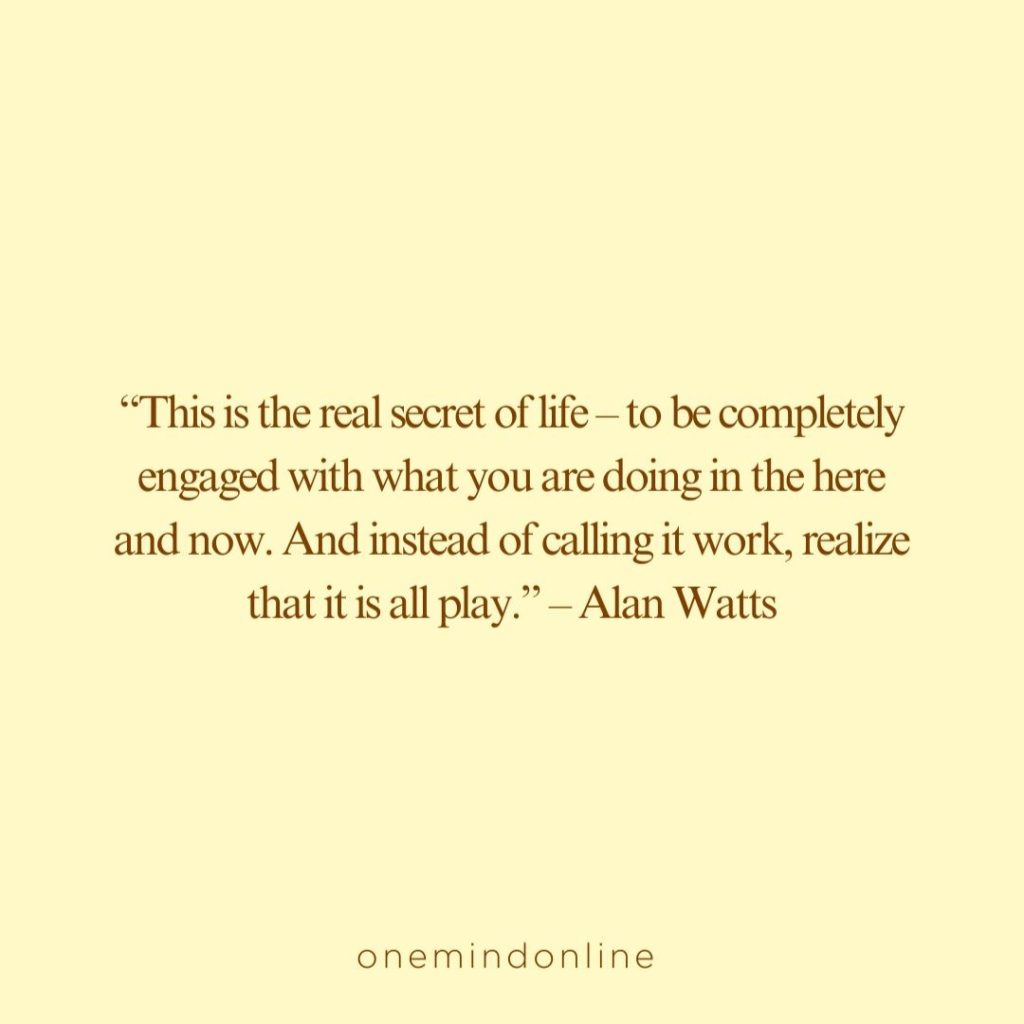
“This is the real secret of life – to be completely engaged with what you are doing in the here and now. And instead of calling it work, realize that it is all play.” – Alan Watts
We have within our brain what is called the “Default Mode Network” (DMN), a group of interacting brain regions that are active together when a person is not focused on a task in the outside world.
Typically when we have downtime, when a task or event in our outer world is not capturing our attention, then the default mode network springs into action. Even though the DMN serves essential human functions such as our ability to learn, to reflect and also plan for the future, it really is a double edged sword. Because the exact same system is also used to ruminate over past regrets, and worry about future uncertainties in endless repeating thought patterns, which can of course significantly hinder productivity and overall well-being.
While it’s quite normal for our default mode network to be more active when we have downtime, it can also “hijack” our attention while we’re trying to be focused, constantly leading our thoughts away from the task that we should be pouring our energy into, and this is an area that shows huge improvement through regular meditation.
Brain science clearly shows that over time, regular meditators have reduced activity in their DMN and they get stuck in “negative mind loops” for shorter periods of time.
As we practice mindfulness, we are training our monkey minds to stay anchored in the present moment, lessening the grip of distracting thoughts. This increased focus not only enhances productivity but also fosters a sense of calm and clarity.
Today’s meditation journey is a game designed to strengthen your focus muscle. By engaging in this practice, you have the opportunity to direct your attention with conscious awareness, increasing your ability to stay on task and experience a deeper sense of fulfillment.
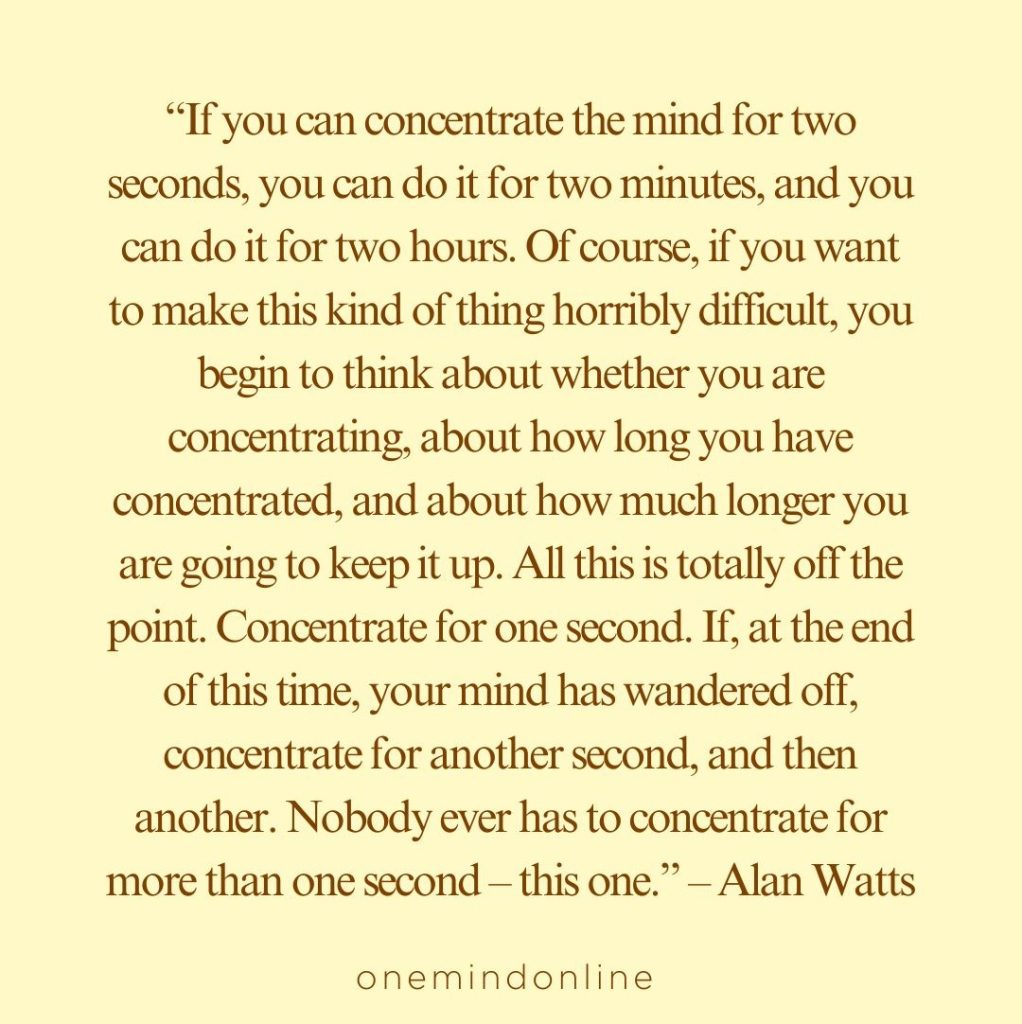
“If you can concentrate the mind for two seconds, you can do it for two minutes, and you can do it for two hours. Of course, if you want to make this kind of thing horribly difficult, you begin to think about whether you are concentrating, about how long you have concentrated, and about how much longer you are going to keep it up. All this is totally off the point. Concentrate for one second. If, at the end of this time, your mind has wandered off, concentrate for another second, and then another. Nobody ever has to concentrate for more than one second – this one.” – Alan Watts
Come have a bit of fun with us and see if you can keep your mind focused during today’s meditation journey.
Here are some tools to improve your ability to tame the monkey mind:
- One Moment at a Time: Fully immerse yourself in what deserves your attention right now, whether it’s work, play, or simply being.
- Observe Your Thoughts: Watch your thoughts as they arise and leave, without attaching to them.
- Cultivate Self-Compassion: Treat yourself with kindness and understanding, recognizing that it’s natural for the mind to wander.
- A Gentle Return: Develop the awareness that recognizes when your mind slips into unhelpful rumination, and gently return yourself to where your attention needs to be.
The superpower is not to have a mind that never becomes distracted, that’s just not a practical approach. Here is what you can become a pro at though – growing the awareness that catches every unhelpful thought, and gently redirects the mind to a healthier point of view.
– pierre –
Today’s LIVE meditation is: Focus.
Today’s LIVE meditation
https://youtu.be/GtwTFaAzRMA 2024
https://youtu.be/Ll9qhPVa3sM 2023
https://youtu.be/SDC8HUW2mN4 2022
Practice the “Daily Dose”
Let’s put it into practice! Choose what works for you – daily, once a week or whenever inspiration strikes. Putting pen to paper wires the neural pathways that will create your new habits.
1 – Affirmation
Not really affirmations today, but a few principles that help tame the monkey mind. Write down your favourite one and place it somewhere that you’ll be able to see it the whole day.
- One Moment at a Time: Fully immerse yourself in what deserves your attention right now, whether it’s work, play, or simply being.
- Observe Your Thoughts: Watch your thoughts as they arise and leave, without attaching to them.
- Cultivate Self-Compassion: Treat yourself with kindness and understanding, recognizing that it’s natural for the mind to wander.
- A Gentle Return: Develop the awareness that recognizes when your mind slips into unhelpful rumination, and gently return yourself to where your attention needs to be.
2 – A moment of reflection
Use today’s question as a journal prompt. If you don’t have the time to sit down and write, just take a moment to reflect on your response.
Work as Play: Alan Watts suggests we should “realize that it is all play” rather than calling our activities “work.” Think about an activity you currently label as “work” or “obligation” or “responsibility”. Could you redesign your relationship with this activity? What would shift in your experience if you approached it as play? What would need to change in your mindset or approach to make this transformation possible?
3 – Quotes to share
Send a quote to someone who needs it, or share them all on social media to spread the good vibes!

4 – Q&A for deeper learning
Read through the questions and answers and write down at least one “aha moment” that clicked for you.
Q1: What exactly is the Default Mode Network, and is it good or bad?
A: The Default Mode Network (DMN) is a group of interconnected brain regions that activate when you’re not focused on external tasks. It’s neither inherently good nor bad—it’s essential for learning, reflection, and planning. However, it becomes problematic when it hijacks your attention during tasks requiring focus or traps you in cycles of rumination and worry. Think of it as a useful tool that sometimes runs when you don’t need it.
Q2: How long does it take for meditation to reduce DMN activity?
A: It’s not so much that meditation reduces DMN activity. Meditators become better at recognizing when they are in a state of rumination, and over time regular meditators find it easier to step out of rumination and return their attention to something more helpful.
Q3: If my mind wanders constantly, does that mean I’m bad at meditation?
A: Absolutely not. A wandering mind doesn’t mean you’re failing at meditation—it means you’re human. The practice isn’t about preventing thoughts from arising; it’s about noticing when they do and gently redirecting your attention. Each time you catch your wandering mind, you’re actually succeeding at meditation, not failing. That moment of awareness is the practice itself.
Q4: What’s the difference between healthy reflection and unhelpful rumination?
A: Healthy reflection involves purposefully examining past experiences to learn and grow, then moving forward with insights. Rumination is repetitive, circular thinking about problems or regrets without reaching resolution or taking action. Reflection feels productive and usually has a natural endpoint; rumination feels stuck and draining. If you’re replaying the same thoughts without new understanding, you’ve likely crossed into rumination.
Q5: Can I really only focus for “one second” as Alan Watts suggests?
A: Watts’ point is philosophical rather than literal. He’s emphasizing that we only ever live in the present moment—this one second, right now. By focusing on just this moment rather than worrying about maintaining concentration for extended periods, we remove the pressure and paradoxically make sustained focus more achievable. It’s about breaking the overwhelming task of “staying focused” into an infinite series of manageable single moments.
Q6: What if I don’t have time for regular meditation practice?
A: Mindfulness doesn’t require setting aside large blocks of time. You can practice meditative presence during everyday activities. Make a meditation of your morning coffee for instance – practice having your thoughts be fully engaged with the experience. Feel the mug in your hands, smell the aroma, taste the flavour profile and notice when your mind wanders away from the coffee to anything else. Now be deliberate about directing your attention back to the coffee again and again, as many times as it takes until the cup is empty. Then remind yourself to apply the same exercise to being completely attentive during a conversation, or bringing awareness to your breathing while waiting in line. These micro-practices of returning your attention to the present moment build the same mental muscle as formal meditation.
Q7: How do I practice self-compassion when my distracted mind affects my work or relationships?
A: Self-compassion starts with recognizing that a wandering mind is a universal human experience, not a personal failing. When distraction affects your performance, acknowledge the difficulty without harsh self-judgment: “This is hard, and I’m doing my best.” Treat yourself as you would a good friend struggling with the same challenge. Then, take constructive action by gently redirecting your attention and implementing strategies that support your focus, all while maintaining kindness toward yourself in the process.