
“Your Daily Dose” is a quick two minute read packed with bite-sized wisdom from all the great teachers. But you could also choose to turn it into something more… a powerful daily practice for personal growth. Give it a try!
A message from today’s meditation:
I love reserving the silent meditations for Sundays. And while today’s Hafez quotes are great for leading us into silence, they make me hopeful for humanity as well.
Hafez was a Muslim Sufi who lived in Iran during the 1300’s, just after “The Crusades” when all of the Christian and Muslim world was at war with one another. And if he could see a beautiful unity in all religions back then, then surely we can also:
“I have learned so much from God that I can no longer call myself a Christian, a Hindu, a Muslim, a Buddhist, a Jew. The Truth has shared so much of Itself with me that I can no longer call myself a man, a woman, an angel, or even a pure Soul. Love has befriended me so completely it has turned to ash and freed me of every concept and image my mind has ever known.” – Hafez
“I am in love with every church, And mosque, And temple, And any kind of shrine because I know it is there that people say the different names of the One God.” – Hafez
Hafez extends the thought of finding the same one God in the holy places of every religion to the possibility of seeing God in everyone and everything:
BELOVED EVERYWHERE
“Start seeing everything as God. But keep it a secret. Become like a man who is awestruck and nourished listening to a golden nightingale sing in a beautiful foreign language while God – invisible to most – nests upon its tongue. When a dog runs up to you wagging its ecstatic tail, you lean down and whisper in its ear, ‘Beloved, I am so glad you are happy to see me. Beloved, I am so glad, so very glad you have come.’” – Hafez
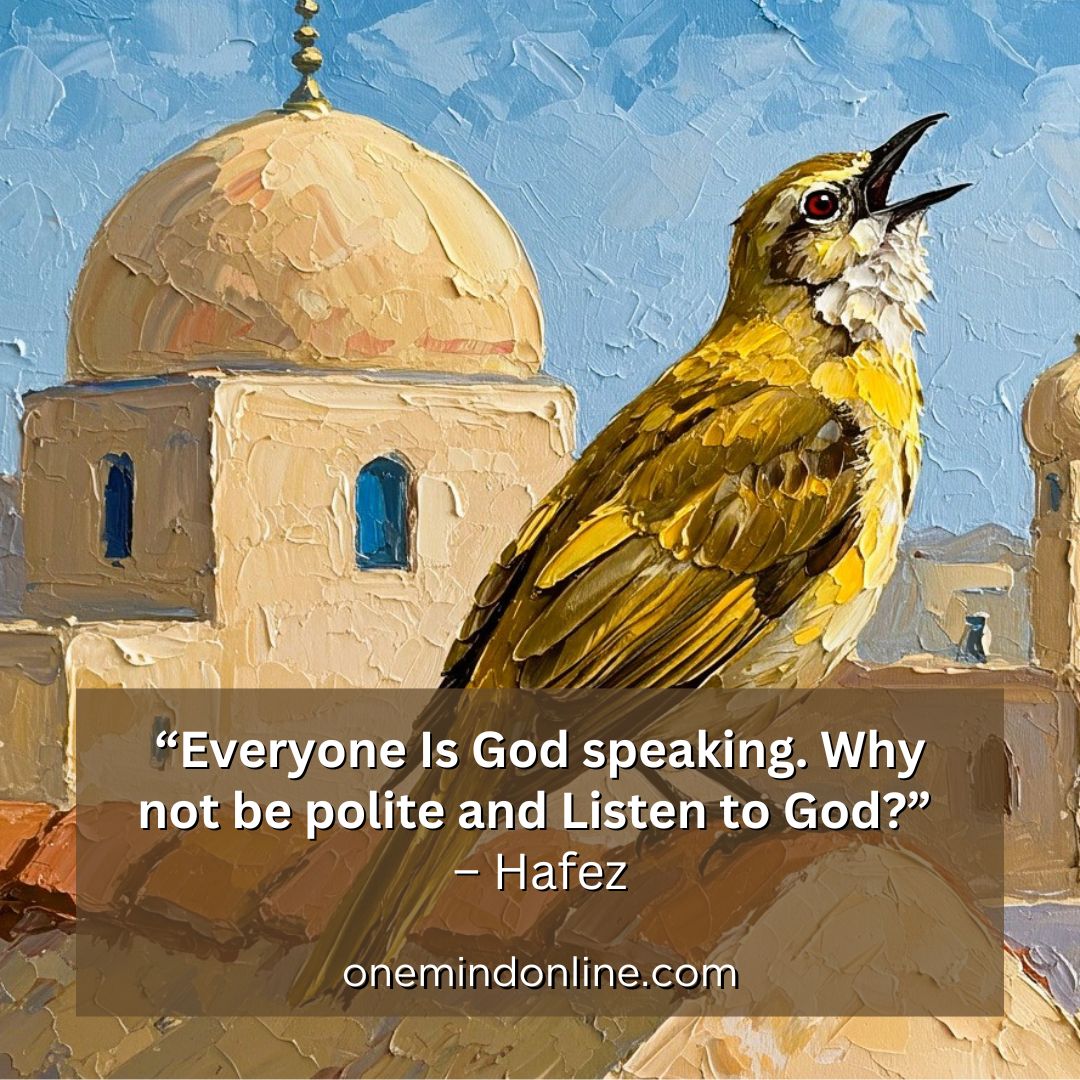
“Everyone Is God speaking. Why not be polite and Listen to God?” – Hafez
I particularly love the thought: “…see everything as God, but keep it a secret…” which to me says yes, develop the ability to see God in everything but don’t go around trying to convince everyone to see things your way. Allow people to show up just as they are, and make it YOUR job to see them as God.
“A day of Silence can be a pilgrimage in itself. A day of Silence can help you listen to the Soul play its marvelous lute and drum. Is not most talking A crazed defense of a crumbling fort?” – Hafez
Make a regular practice of silence and you’ll find stillness to be a pilgrimage in and of itself. A pilgrimage to where you may ask? Just like any other holy pilgrimage it leads to the presence of God which – if you have learned to see God in everything – you’ll know that the most profound presence of God is to be found in the stillness of YOU.
A few thoughts to reflect on:
- Learn to see God in everything, and everyone.
- Cultivate a sense of awe and wonder in the smallest things.
- Allow others to express their own spirituality, in their own way.
- The most profound presence of God is to be found in the stillness of your own heart.
By cultivating a sense of awe, wonder, and respect for all beings, we can find the divine in every moment, every encounter, and every aspect of our lives. As we journey inward, we may discover that the most profound presence of God is to be found in the stillness of our own hearts.
Have a beautiful Sunday.
– pierre –
Today’s LIVE meditation is: Finding silence.
Today’s LIVE meditation
https://youtu.be/TG3nBGXjl0k 2025
https://youtu.be/GEpZkTI_x2g 2024
https://youtu.be/E_MG-I9v-ug 2023
https://youtu.be/UUpqIe36veM 2022
Practice the “Daily Dose”
Let’s put it into practice! Choose what works for you – daily, once a week or whenever inspiration strikes. Putting pen to paper wires the neural pathways that will create your new habits.
1 – Affirmation
Write down your favourite affirmation on a sticky note and place it somewhere that you’ll be able to see it the whole day.
- Learn to see God in everything, and everyone.
- Cultivate a sense of awe and wonder in the smallest things.
- Allow others to express their own spirituality, in their own way.
- The most profound presence of God is to be found in the stillness of your own heart.
2 – A moment of reflection
Use today’s question as a journal prompt. If you don’t have the time to sit down and write, just take a moment to reflect on your response.
Sacred Seeing Practice: Hafez teaches us to “start seeing everything as God, but keep it a secret.” Think about a recent interaction you had with someone who challenged or irritated you. Now reimagine that encounter through the lens of sacred seeing – are you able to see that person as a part of God expressed in a human experience? Did you miss the invitation to respond from your own divine self? How might your response have been different if you had seen them as beloved? Write about how this shift in perspective changes not just how you view others, but how you understand your own role in every interaction.
3 – Quotes to share
Send a quote to someone who needs it, or share them all on social media to spread the good vibes!
4 – Q&A for deeper learning
Read through the questions and answers and write down at least one “aha moment” that clicked for you.
Q1: Isn’t “seeing everything as God” just spiritual bypassing or avoiding real problems?
Sacred seeing isn’t about pretending harm doesn’t happen or excusing it – it’s about understanding that no person can act from a level of consciousness they haven’t yet grown into. Humanity is still moving through its long, uneven process of maturation, and someone’s inability to grasp the full weight of their actions doesn’t erase the truth that they, too, are a soul having a human experience, just like you. At the same time, ignorance can and does cause real harm, and love was never meant to ask us to place ourselves in its path – doing so would mean failing to love ourselves. This is why sacred seeing and firm boundaries aren’t in conflict; you can honor the divinity within someone while still stepping back, saying no, or protecting your own wellbeing. Holding both truths at once – compassion for where someone is, and clarity about what you will and won’t accept – is what we call wisdom.
Q2: Why does Hafez say to “keep it a secret” when seeing God in everything?
Keeping it a secret is really about tending your own garden rather than reaching over the fence to rearrange someone else’s. Hafez isn’t suggesting we hide our insights or never speak of what we’ve learned – sharing wisdom, when it’s welcomed, is part of how truth moves through the world. What he’s cautioning against is the impulse to force our way of seeing onto others, as if our spiritual growth gives us the authority to dictate theirs. Each person’s relationship with the divine unfolds on its own timeline, through its own experiences, and it isn’t ours to rush or correct. So the “secret” is less about concealment and more about restraint – doing the quiet, patient work of growing in your own life, and trusting that this inner transformation speaks for itself, without needing to convince anyone of anything.
Q3: How can I practice sacred seeing with people who have hurt me or whom I find difficult?
Start small and be patient with yourself. Sacred seeing doesn’t require you to excuse harmful behaviour or put yourself in danger. It’s about recognizing the divine spark even in those who’ve forgotten it themselves. Begin by silently acknowledging that this person, like you, seeks happiness and fears suffering. You might internally say, “This is a soul having a difficult human experience.” This practice is for your own spiritual growth, not for their benefit.
Q4: Does this approach mean all religions are the same?
No, Hafez isn’t suggesting all religions are identical. Different traditions have unique practices, beliefs, and wisdom. What he’s pointing to is the universal human longing for connection with the divine that underlies all spiritual seeking. It’s like different languages expressing the same fundamental human emotions – the expressions vary, but the core experience is universal. This perspective allows us to honor differences while recognizing common ground.
Q5: What if I don’t believe in God? Can this practice still work for me?
Absolutely. Replace “God” with whatever represents the highest good to you – universal love, consciousness, the interconnectedness of all life, or simply the inherent worth and dignity of every being. The practice is about recognizing something sacred and worthy of reverence in everyone and everything. Whether you call it God, Buddha nature, the divine spark, or simply shared humanity, the transformative power remains the same.
Q6: How can silence help me develop this way of seeing?
Silence creates space for deeper perception. In our noisy world, we often react to surface appearances rather than truly seeing. Regular silence practices – whether meditation, quiet walks, or simply sitting still – help quiet the mental chatter that keeps us trapped in judgment and separation. In stillness, we can access the part of ourselves that naturally recognizes the sacred. As Hafez suggests, silence becomes a pilgrimage to the divine presence within us, which then makes it easier to recognize that same presence everywhere else.