

“Your Daily Dose” is a quick two minute read packed with bite-sized wisdom from all the great teachers. But you could also choose to turn it into something more… a powerful daily practice for personal growth. Give it a try!
A message from today’s meditation:
In today’s journey, Buddhist monk Thich Nhat Hanh speaks to us about dealing with overwhelming emotions. We all have those moments where emotions feel like a tidal wave, threatening to engulf us. Thich Nhat Hanh suggests a simple, yet powerful way to weather the storm.
“Every time you have an energy that needs to be transformed like jealousy or fear, do something to care for this energy if you do not want it to destroy you. When you have pain within you the first thing you have to do is bring the energy of mindfulness to embrace the pain … ‘I know you are there, little anger, my old friend. Breathe – I am taking care of you now’. You will be able to look deeply at the true nature of your anger. This discovery, this understanding, this wisdom, will liberate you from your pain.” – Thich Nhat Hanh
He starts this piece with “…Every time you have an energy that needs to be transformed…” this approach is something we can apply to any of our internal triggers. The examples that he uses are anger, jealousy or fear, but it works equally well for any of our big emotions – frustration, sadness, impatience – they are all just calling to be held in the arms of your awareness.
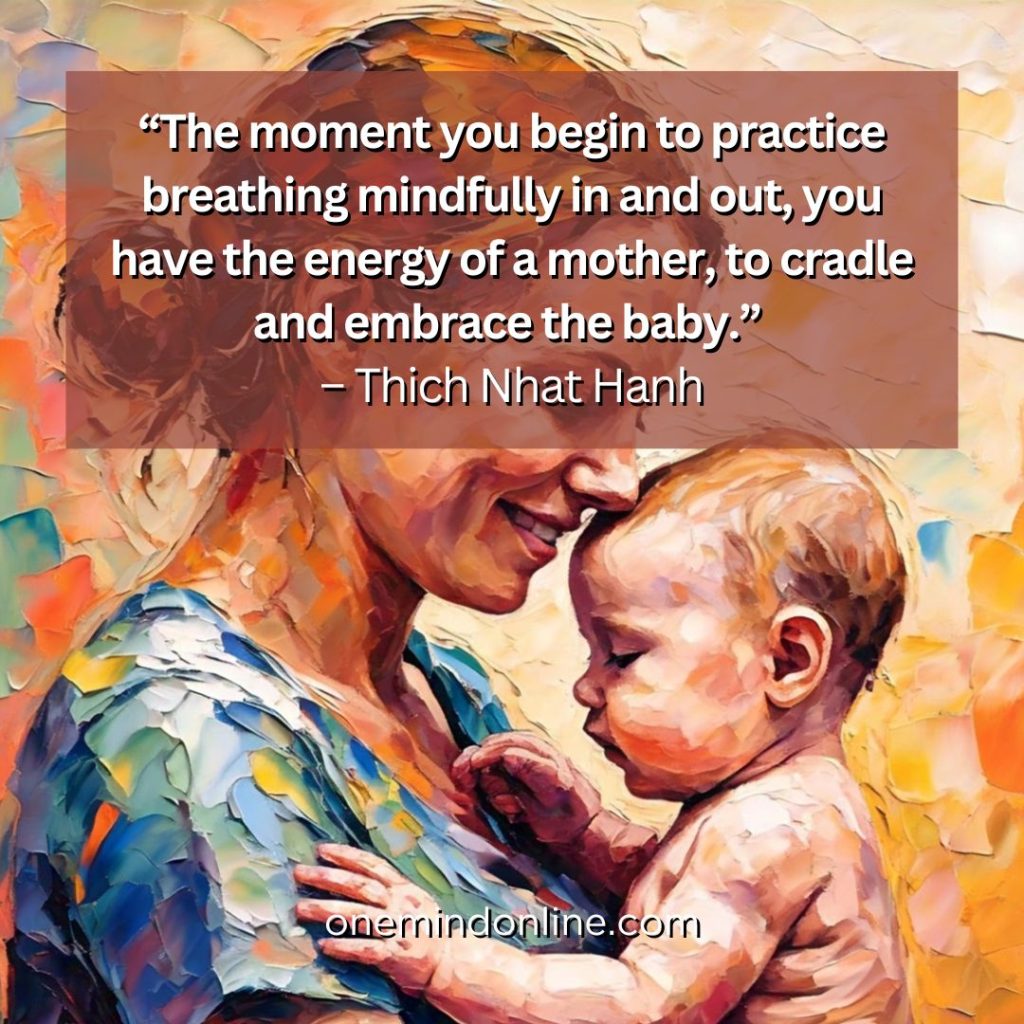
“The moment you begin to practice breathing mindfully in and out, you have the energy of a mother, to cradle and embrace the baby. Just embracing your anger, just breathing in and breathing out, that is already good enough. The baby will feel relief right away.” – Thich Nhat Hanh
Imagine a small child who has fallen and scraped their knee. Often, the most comforting thing is simply to be held, to feel the warmth of a loving presence. Similarly, when we are experiencing emotional distress, mindful breathing acts as a form of self-compassionate holding. By gently turning our attention towards the breath, we begin to witness the emotion without judgment. By holding – by witnessing – this leads over time to seeing, to understanding the true origin of the pain, the anger, the fear.
I love his beautiful description, “The moment you begin to practice breathing mindfully, you have the energy of a mother.” It always starts with breath. The moment that we put everything else down and take the time to – even for a little while – become aware of the rising and falling of our body as we breathe, in this moment we step into the part of ourselves that knows how to nurture, how to hold whatever is hurting.
To get better at this, we need to remind ourselves to breathe in those moments when the going gets tough. Whether it’s the storm within us or a storm around us, it’s our breath that gives us the ability to take a step backwards and observe, “how am I dealing with this change in the weather right now?”
Mantras for emotional mastery:
- “I am aware of my emotions.”
- “I breathe through my emotions.”
- “I am safe and supported.”
- “I am the mountain, not the storm.”
Remember, you are the mountain, not the storm. You possess an inner strength that can weather any emotional tempest and emerge stronger and more resilient.
– pierre –
Today’s LIVE meditation is: I am the mountain
Today’s LIVE meditation
https://youtu.be/zTQe2IxMyz0 2026
https://youtu.be/ym6di2hABuw 2025
https://youtu.be/wY-8jbnhxEg 2024
https://youtu.be/vMja1Q5u7e8 2022
Practice the “Daily Dose”
Let’s put it into practice! Choose what works for you – daily, once a week or whenever inspiration strikes. Putting pen to paper wires the neural pathways that will create your new habits.
1 – Affirmation
Write down your favourite affirmation on a sticky note and place it somewhere that you’ll be able to see it the whole day.
- “I am aware of my emotions.”
- “I breathe through my emotions.”
- “I am safe and supported.”
- “I am the mountain, not the storm.”
2 – A moment of reflection
Use today’s question as a journal prompt. If you don’t have the time to sit down and write, just take a moment to reflect on your response.
The Mountain and the Storm: Write about a situation where you successfully remained “the mountain” while emotions stormed around or within you. What allowed you to maintain that grounded presence? How can you access that strength more consistently?
3 – Quotes to share
Send a quote to someone who needs it, or share them all on social media to spread the good vibes!
4 – Q&A for deeper learning
Read through the questions and answers and write down at least one “aha moment” that clicked for you.
Q1: What does it mean to “embrace” a difficult emotion rather than fight it?
Embracing an emotion means acknowledging its presence without judgment, much like holding a crying child. Instead of pushing the feeling away or telling yourself you shouldn’t feel it, you simply recognize: “I see you, I’m here with you.” This compassionate witnessing creates space for the emotion to naturally transform rather than intensify through resistance.
Q2: How can breathing actually change how I feel emotionally?
Mindful breathing activates your parasympathetic nervous system, which calms the body’s stress response. More importantly, focusing on your breath creates a gentle distance between you and the overwhelming emotion—you become the observer rather than being completely consumed. This shift in perspective allows you to see the emotion more clearly and respond rather than react.
Q3: I get so caught up in my emotions that I forget to breathe. How can I remember in the moment?
This is a common challenge. Start by practicing mindful breathing when you’re calm, so it becomes a familiar tool. You can also create reminders: set periodic phone alerts, place sticky notes in visible locations, or establish “breathing triggers” (like every time you open a door or check your phone). Over time, the practice becomes more automatic.
Q4: What if I don’t feel any relief right away when I try this technique?
Relief may come gradually rather than instantly. The practice isn’t about making emotions disappear immediately—it’s about changing your relationship with them. Some emotions carry deep roots that need patient attention over time. Trust that each moment of mindful breathing plants a seed, even if you don’t see immediate results.
Q5: Can this approach work for trauma or very intense emotional pain?
While mindful breathing is powerful, severe trauma often requires professional support. This technique can be part of a healing toolkit, but trauma work really benefits from the guidance of a trained therapist. If emotions feel too overwhelming or destabilizing, please seek professional help rather than trying to navigate them alone.
Q6: What does “looking deeply at the true nature” of an emotion actually mean?
It means investigating beneath the surface feeling to understand its origin. For example, anger might really be trying to protect an old wound; and jealousy might really be about and unmet need. By breathing and observing without judgment, you create space to ask: “What is this emotion protecting? What does it need? Where did it learn to respond this way?” This understanding is what liberates you.
Q7: How is being “the mountain” different from suppressing emotions?
Being the mountain means remaining grounded and stable while fully experiencing emotions—the mountain doesn’t deny the storm, it simply isn’t moved by it. Suppression involves pushing emotions down and pretending they don’t exist. The mountain acknowledges the weather while recognizing its own unchanging nature. You feel everything fully but aren’t swept away by it.