“Your Daily Dose” is a quick two minute read packed with bite-sized wisdom from all the great teachers. But you could also choose to turn it into something more… a powerful daily practice for personal growth. Give it a try!
A message from today’s meditation:
Words can be beautiful tools, painting vibrant landscapes of imagination and sharing the whispers of the heart. Yet, some truths dance just beyond the grasp of words, like moonlight on water, shimmering and elusive. Lao Tzu, the ancient philosopher, understood this dance intimately.
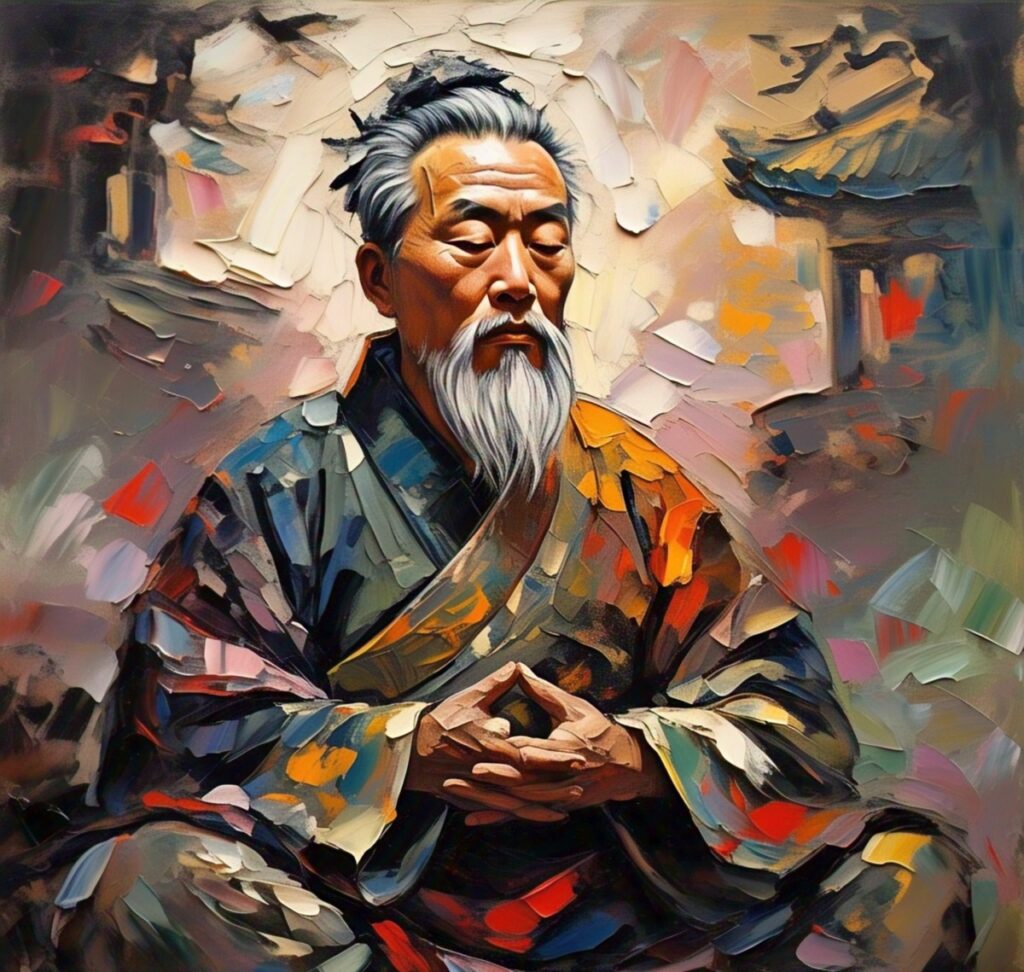
In the last part of Lao Tzu’s life, he was old, and believed he had come to the end of his usefulness. He had had enough of society and the city and decided that he would move out to the mountains to live out the last days of his life in peace.
As he passed a border post, the soldier in charge of customs recognized him and asked him where was traveling to, upon which Lao Tzu answered that this was in fact his last journey, into the mountains…
The soldier was sad and upset and was hesitant in allowing him to pass saying, “Master you can’t go without leaving us your wisdom, please write it down, tell us what is the way in which to live a virtuous life?!”
Lao Tzu took out his tools, sat under a tree and wrote the 81 verses of the Tao Te Ching. But instead of leaving a list of commandments or a rigid roadmap, he made it clear that “truth” is not so easy to nail down in words, and that true understanding requires a subtle approach. The very first words he wrote were…
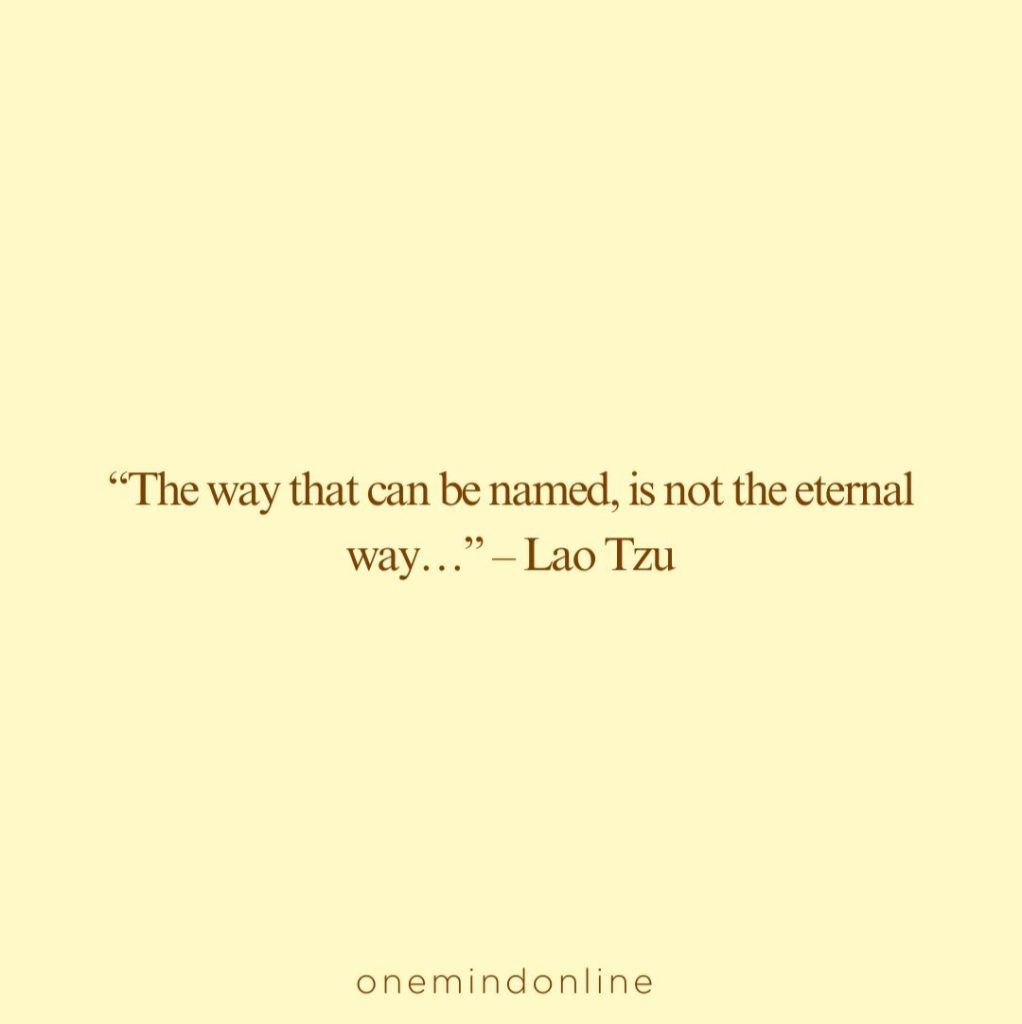
“The way that can be named, is not the eternal way…” – Lao Tzu
Trying to describe the perfect path in something like one final recipe that works for everyone is just not how this works. It’s like trying to describe the indescribable…
It’s like trying to describe the indescribable…
Trying to distill “truth” into words always limits it to narrow one dimensional reductions which our human minds often force into our own boxes of prior conceived biases… missing the point… reinforcing old beliefs instead of challenging them… but we have to try regardless, because words are how we communicate.
So many of our questions about how to live life well, asks for a description of the indescribable and cannot be answered in the simple way we seek. Lao Tzu does the best job of trying to describe the indescribable that I have ever come across:
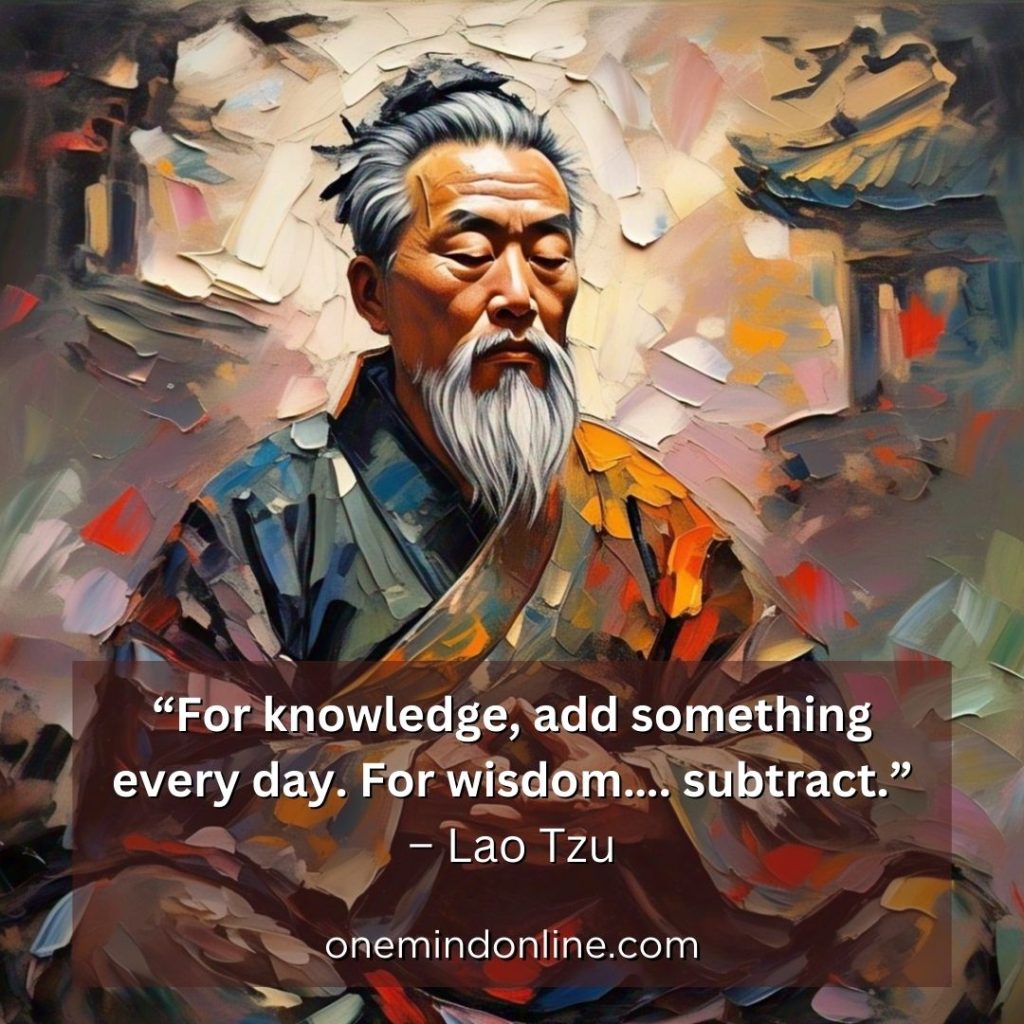
“For knowledge, add something every day. For wisdom…. subtract.” – Lao Tzu
“Be empty. Be still. Just watch everything come and go. This is the way of Nature.” – Lao Tzu
“Be still. Stillness reveals the secrets of eternity.” – Lao Tzu
“Thirty spokes meet in the hub, but the empty space between them is the essence of the wheel.
Pots are formed from clay, but the empty space within it is the essence of the pot.
Walls with windows and doors form the house, but the empty space within it is the essence of the home.” – Lao Tzu
“Look, and it can’t be seen.
Listen, and it can’t be heard.
Reach, and it can’t be grasped.
Above, it isn’t bright.
Below, it isn’t dark.
Seamless, unnameable,
it returns to the realm of nothing.
Form that includes all forms,
image without an image,
subtle, beyond all conception.
Approach it and there is no beginning;
follow it and there is no end.
You can’t know it, but you can be it,
at ease in your own life.
Just realize where you come from:
this is the essence of wisdom.”
– Lao Tzu
“Become totally empty, quiet the restlessness of the mind, only then will you witness everything unfolding from emptiness.” – Lao Tzu
“At the center of your being you have the answer; you know who you are and you know what you want.” – Lao Tzu
I always feel like I need to bring these kinds of teachings into balance by pointing out the opposite side too. All of these teachings sometimes make it sound like no action is needed, only meditation and being “present”. In his teachings Lao Tzu speaks clearly of the need for putting what we’ve learned into action, but that we tend to overemphasize action, turning our actions into wasted energy at the expense of what we gain from in-action…
“Take action only when necessary, but remember that all action begins in rest… This is the ultimate truth.” – Lao Tzu
I trust that you’ve enjoyed a week of diving into the wisdom of Lao Tzu.
Embrace these mantras as you navigate “The Way”:
- “I seek wisdom in observation, trusting that clarity emerges from stillness.”
- “I trust the inner wisdom that knows my truth, even when I cannot yet articulate it.”
- “I recognize that action and stillness are not opposites but partners in living with wisdom.”
- “I allow myself to subtract, to empty, to make space for what truly matters.”
- “My wisest actions arise from moments of deep rest and reflection.”
I wish you a happy Sunday, and a well rested start to your week!
– pierre –
Today’s LIVE meditation is: Finding silence.
Today’s LIVE meditation
https://youtu.be/MJSeH-eMovU 2026
https://youtu.be/m_pnx7Lg_AE 2025
https://youtu.be/ZrDBkEKas1w 2024
https://youtu.be/kq5Tcy29QFc 2023
Practice the “Daily Dose”
Let’s put it into practice! Choose what works for you – daily, once a week or whenever inspiration strikes. Putting pen to paper wires the neural pathways that will create your new habits.
1 – Affirmation
Write down your favourite affirmation on a sticky note and place it somewhere that you’ll be able to see it the whole day.
- “I seek wisdom in observation, trusting that clarity emerges from stillness.”
- “I trust the inner wisdom that knows my truth, even when I cannot yet articulate it.”
- “I recognize that action and stillness are not opposites but partners in living with wisdom.”
- “I allow myself to subtract, to empty, to make space for what truly matters.”
- “My wisest actions arise from moments of deep rest and reflection.”
2 – A moment of reflection
Use today’s question as a journal prompt. If you don’t have the time to sit down and write, just take a moment to reflect on your response.
The Wisdom of Subtraction: Lao Tzu teaches that “for knowledge, add something every day; for wisdom – subtract.” Reflect on your own life: What are you constantly adding – tasks, commitments, information, possessions? What might you need to subtract to create space for deeper wisdom? Write about one thing you could remove from your life this week that would bring you closer to clarity and peace.
3 – Quotes to share
Send a quote to someone who needs it, or share them all on social media to spread the good vibes!

4 – Q&A for deeper learning
Read through the questions and answers and write down at least one “aha moment” that clicked for you.
Q1. What does “The way that can be named is not the eternal way” actually mean?
This opening line of the Tao Te Ching suggests that ultimate truth or reality cannot be fully captured in words or concepts. The moment we try to define or label something as complex as “the way to live” or the nature of existence, we limit it to our narrow human understanding. Lao Tzu is warning us that language, while useful, creates boxes that can trap infinite wisdom into finite definitions. The real “way” must be experienced and lived into, not just intellectually understood.
Q2. Is Lao Tzu saying we should never take action and just meditate all day?
No. While Lao Tzu emphasizes stillness and observation, he also teaches that “action begins in rest” and that we should “take action only when necessary.” The key is balance. He’s critiquing our tendency to engage in frantic, mindless action driven by anxiety or ego rather than wisdom. Actions that arise from inner stillness and clarity are more effective and less wasteful of our energy. It’s about quality over quantity—doing less, but doing it with greater wisdom and intention.
Q3. What is the practical value of “emptiness” in daily life?
When Lao Tzu speaks of emptiness, he’s pointing to the functional space that makes things useful—the hollow of a cup that holds water, or the open room that provides living space. In our lives, this translates to creating margin: unscheduled time, mental quiet, and space for spontaneity and insight. Our culture fills every moment with productivity, information, and noise, but wisdom often emerges in the gaps. Stillness isn’t empty; it’s full of potential and possibility.
Q4. How can I access the “answer at the center of my being” that Lao Tzu mentions?
According to Lao Tzu, this requires stillness and the quieting of mental restlessness. When we’re constantly busy, consuming information, and reacting to external demands, we can’t hear our inner wisdom. Practices like meditation, time in nature, journaling, or simply sitting quietly can help you tune into what you already know deep down. The answer isn’t something you need to search for externally—it’s already within you, waiting to be noticed.
Q5. Why did Lao Tzu initially refuse to write down his teachings?
The story suggests Lao Tzu believed his usefulness in society had ended and he preferred to spend his remaining time in solitary peace in the mountains. But more deeply, his hesitation likely reflected his understanding that wisdom cannot be adequately transmitted through words alone. He knew that writing down “the way” would inevitably reduce it to something fixed and limited. He only agreed because the border guard insisted, and even then, his first words acknowledged the fundamental limitation of what he was about to do.
Q6. What does “for knowledge, add; for wisdom, subtract” mean in practice?
Knowledge is about accumulating information, facts, and skills—you build it through addition. Wisdom, however, often comes from letting go: releasing false beliefs, unnecessary worries, limiting assumptions, and distractions that cloud your judgment. In practice, this might mean consuming less information and spending more time reflecting on what you already know. It might mean saying “no” to commitments that don’t align with your values, or letting go of rigid opinions that prevent you from seeing clearly.
Q7. Can these ancient Eastern teachings really apply to modern Western life?
Absolutely. While Lao Tzu lived over 2,500 years ago in ancient China, the fundamental human challenges he addressed—finding meaning, managing stress, making wise decisions, and understanding our place in the world—remain universal. In fact, his teachings about stillness and emptiness may be even more relevant today, when our lives are more frantic and overstimulated than ever. The principles transcend culture and time because they speak to the core of human experience: the tension between doing and being, the limits of intellectual understanding, and the wisdom that comes from looking inward.