

“Your Daily Dose” is a quick two minute read packed with bite-sized wisdom from all the great teachers. But you could also choose to turn it into something more… a powerful daily practice for personal growth. Give it a try!
A message from today’s meditation:
Today’s message by Sadhguru speaks about peace. We’ve been taught to chase peace as if it were a prize waiting at the finish line. We tell ourselves: “Once I get that promotion, once my relationship is stable, once my finances are sorted – then I’ll finally have peace.” But, Sadhguru turns this kind of thinking upside down.
“There are no problems, only situations. It is all in how you approach them.” – Sadhguru
This thought by Sadhguru reminds me of a line in the poem “If” by Rudyard Kipling that mentions “treating triumph and disaster just the same”. It speaks of the possibility of having the kind of peace that is unaffected by circumstance. Seeing everything that happens not as good or bad, but as an ever changing landscape of experience, and we are invited to choose how we want to respond to it all.
This kind of peace is not to be confused with apathy or passivity. It is accompanied by a keen sense of awareness, not avoidance or escape. An awareness that sees all, yet stays in a calm space.
“Peace is not the highest goal in life, it is the most fundamental requirement.” – Sadhguru
When we get this the wrong way around then we believe that, “I first have to get everything in my life in perfect order, check all the boxes, dot all the i’s and cross all the t’s and THEN… then I’ll have peace.”
And that’s exactly how we ensure that we never get there. The truth is more counterintuitive: we must cultivate peace first, this is what gives us the ability to accept the moving parts of our lives that may never align in perfect order. Peace isn’t what we achieve after solving all our problems – peace is the foundation that allows us to navigate these situations skillfully.
“Life is not about peace. But if you do not know peace, you will never know life.” – Sadhguru
“Health does not always come from medicine. Most of the time it comes from peace of mind, peace in the heart, peace in the soul. It comes from laughter and love.” – Sadhguru
Don’t fall into the trap of thinking that only once you have a life without difficulty, will you be at peace. Peace isn’t the reward, it’s the foundation, and it’s only available if you have acceptance for the messy, ever-changing, beautifully imperfect nature of life itself.
The mountain is peace precisely because it has absolute acceptance for the reality that weather will change, storms will come, seasons will shift. Its stability doesn’t depend on conditions remaining constant.
This is the secret we often miss: our resistance to life’s inherent messiness is what disturbs our peace, not the messiness itself. When we demand that life stop changing, that relationships remain exactly as they are, that our circumstances stabilize permanently before we’ll allow ourselves to feel at peace, we’re fighting against the very nature of existence. We’re essentially saying, “I’ll be the mountain only once the weather is solved.”
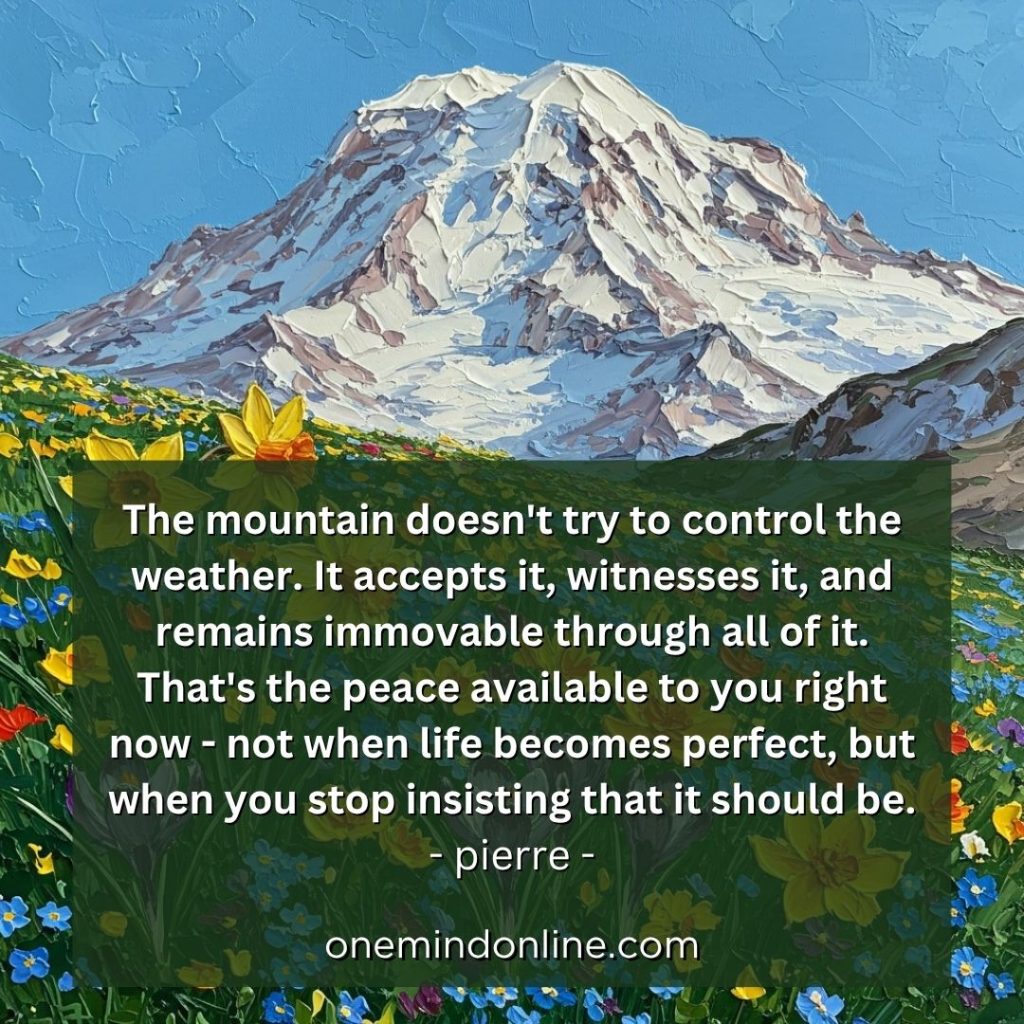
The mountain doesn’t try to control the weather. It accepts it, witnesses it, and remains immovable through all of it. That’s the peace available to you right now – not when life becomes perfect, but when you stop insisting that it should be.
Here are some thoughts to build your foundation of peace:
- Peace is the Starting Point: Let go of the chase for perfect conditions. Instead, cultivate peace as an ongoing practice, a foundation for navigating life’s complexities.
- Reframe Challenges as Situations: Shift your perspective. See obstacles as opportunities to learn, grow, and demonstrate your inner strength.
- Awareness Breeds Calm: The “mountain” observes all – both the good and the bad – but remains centered and unruffled. Develop a keen awareness of your thoughts and emotions without becoming consumed by them.
- Action from Stillness: Peace doesn’t mean inaction. It creates the mental clarity needed to take decisive, informed steps when necessary.
- Laughter and Love are Your Guides: These are the natural expressions of a peaceful heart. Invite them into your life to nurture your inner mountain.
Join us in today’s meditation for a very practical journey into finding a mountain of peace within you.
– pierre –
Today’s meditation: I am the mountain.
Today’s LIVE meditation
https://youtu.be/N3PcvyMc6Zs 2026
https://youtu.be/pVPlC3zvXBo 2024
https://youtu.be/ZEcm86uFs6o 2023
Practice the “Daily Dose”
Let’s put it into practice! Choose what works for you – daily, once a week or whenever inspiration strikes. Putting pen to paper wires the neural pathways that will create your new habits.
1 – Affirmation
Here are some thoughts to build your foundation of peace. Write your favourite one on a sticky note and place it somewhere that you’ll be able to see it the whole day.
- Peace is the Starting Point: Let go of the chase for perfect conditions. Instead, cultivate peace as an ongoing practice, a foundation for navigating life’s complexities.
- Reframe Challenges as Situations: Shift your perspective. See obstacles as opportunities to learn, grow, and demonstrate your inner strength.
- Awareness Breeds Calm: The “mountain” observes all – both the good and the bad – but remains centered and unruffled. Develop a keen awareness of your thoughts and emotions without becoming consumed by them.
- Action from Stillness: Peace doesn’t mean inaction. It creates the mental clarity needed to take decisive, informed steps when necessary.
- Laughter and Love are Your Guides: These are the natural expressions of a peaceful heart. Invite them into your life to nurture your inner mountain.
2 – A moment of reflection
Use today’s question as a journal prompt. If you don’t have the time to sit down and write, just take a moment to reflect on your response.
The Peace-First Experiment: Reflect on an area of your life where you’ve been waiting for circumstances to align before you’ll allow yourself to feel at peace. What would it look like to cultivate peace first? What would have to change in the way you see things for you be be at peace even if that situation doesn’t resolve? How might being at peace shift how approach the situation itself?
3 – Quotes to share
Send a quote to someone who needs it, or share them all on social media to spread the good vibes!
4 – Q&A for deeper learning
Read through the questions and answers and write down at least one “aha moment” that clicked for you.
Q1: Isn’t seeking peace just another form of avoidance or spiritual bypassing?
Not at all. Genuine peace is accompanied by keen awareness, not escape. The difference lies in whether you’re running from difficult emotions and situations or developing the capacity to remain centered while fully experiencing them. Peace gives you the clarity to address challenges skillfully rather than reactively.
Q2: How can I find peace when my life genuinely has serious problems that need solving?
This is precisely why peace must come first. When you’re in a state of internal chaos, you can’t think clearly, make wise decisions, or take effective action. Peace isn’t about denying your problems—it’s about creating the mental and emotional foundation from which you can actually solve them. The mountain doesn’t ignore the storm; it simply isn’t overwhelmed by it.
Q3: What’s the practical difference between treating something as a “problem” versus a “situation”?
A “problem” carries an emotional charge—it’s framed as wrong, threatening, or something that shouldn’t be happening. A “situation” is neutral—it simply is. This reframe removes the resistance and emotional reactivity, allowing you to see clearly and respond wisely. It’s the difference between “Why is this happening to me?” and “What’s actually happening here, and what’s my best move?”
Q4: How does inner peace actually affect physical health and the nervous system?
Your nervous system responds to your mental and emotional state. Chronic stress, anxiety, and inner turmoil keep you in sympathetic (fight-or-flight) activation, which suppresses immune function, disrupts digestion, affects sleep, and creates inflammation. Cultivating peace activates the parasympathetic (rest-and-digest) system, allowing your body to heal, regenerate, and function optimally.
Q5: Can I really have peace while still caring deeply about outcomes?
Yes. Peace doesn’t mean not caring—it means not being destabilized by uncertainty or attachment to specific outcomes. You can work passionately toward goals while accepting that the results aren’t entirely in your control. This is what Kipling meant by treating “triumph and disaster just the same”—full engagement without being emotionally hijacked by results.
Q6: What if life circumstances are objectively terrible? Isn’t pursuing peace then just toxic positivity?
Peace is not about pretending everything is fine when it isn’t. It’s about maintaining your center so you can face difficulties with clarity and strength rather than being overwhelmed by them. In genuinely terrible circumstances, your inner stability becomes even more crucial—it’s what allows you to endure, to help others, and to find your way through. Peace is resilience, not denial.
Q7: How do I start building this “foundation of peace” when I feel far from peaceful right now?
Start exactly where you are. Begin with small moments of awareness—notice your breath, observe your thoughts without judgment, practice reframing one “problem” as a “situation.” Peace is developed through consistent practice, not perfection. Even acknowledging that peace is a foundation rather than a destination is a powerful shift. Build your mountain one conscious moment at a time.