“Your Daily Dose” is a quick two minute read packed with bite-sized wisdom from all the great teachers. But you could also choose to turn it into something more… a powerful daily practice for personal growth. Give it a try!
A message from today’s meditation:
Imagine… stepping beyond the buzzing hive of thoughts, anxieties, and to-do lists. Beyond the judgments, doubts, and endless noise of the “doing” mind. There, in the hushed space between breaths, lies a field. Not a field of grass or wildflowers, but a field of pure potentiality, of unbridled connection, of a love whispered in the quiet hum of existence.
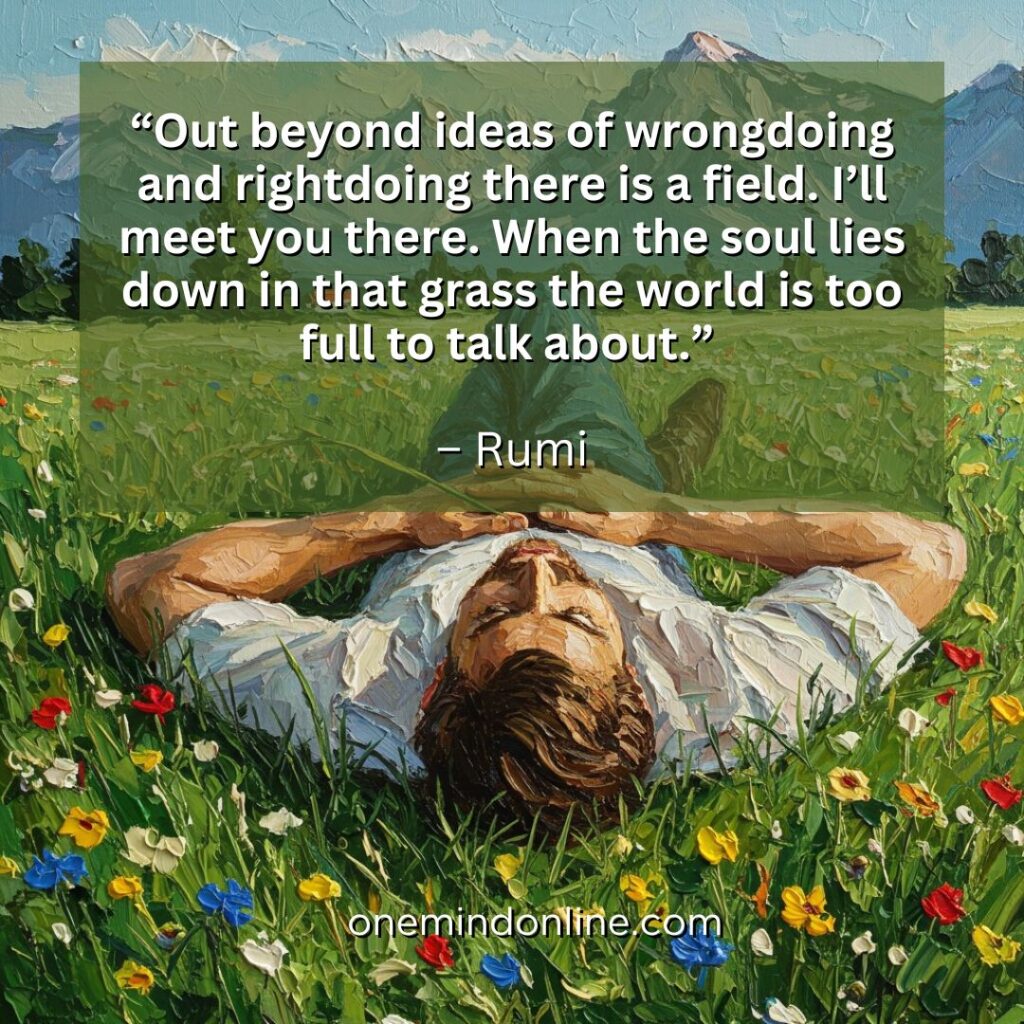
Rumi, that soul-weaver of words, beckons us there:
“Out beyond ideas of wrongdoing and rightdoing there is a field, I’ll meet you there. When the soul lies down in that grass the world is too full to talk about. Ideas, language, even the phrase ‘each other’ doesn’t make any sense.” – Rumi
The spiritual teacher and story teller, Robert Rabbin, echoes the call:
“Just beyond the thinking mind is an unending field of love and quiet beauty. One can lie down there, and live in eternity. This field cannot be seen by the mind, it cannot be known by the mind; it can only be felt and found with the heart.” – Robert Rabbin
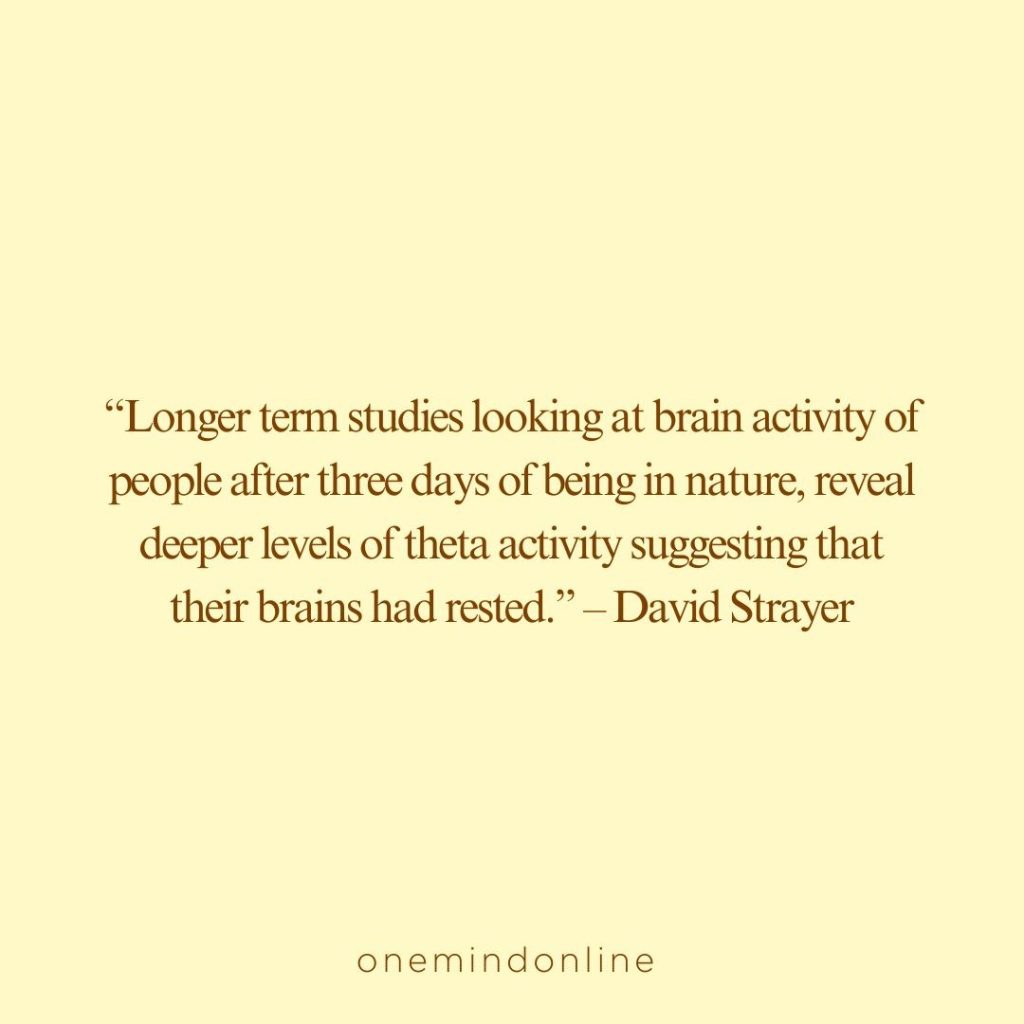
And science, our modern bard, chimes in:
“Longer term studies looking at brain activity of people after three days of being in nature, reveal deeper levels of theta activity suggesting that their brains had rested.” – David Strayer
There, in that field, words fail. Rumi’s world, “too full to talk about,” Rabbin’s “unending field of love,” and the quietude of nature itself, all point to a space where our harried minds simply rest. No striving, no chasing, just being.
So, whether it’s Rumi’s field, Rabbin’s love-filled expanse, or the silent symphony of the natural world, there’s a primal sanctuary waiting for us just beyond the chatter of our minds. A place where stillness recharges, where beauty inspires, and where the soul, finally, can breathe.
Join us as we slip into that endless field of potential together.
Ready to unplug and unfurl? Here are your guiding mantras:
- The soul lies down in that grass – Find the meadow within your mind.
- Just beyond the thinking mind – Put the “busy-ness” down, embrace presence.
- Nature reveals lower levels of theta activity – Seek stillness, find rest.
- Remember, you belong – In this field of quiet beauty, you’re not just a visitor, you’re home.
If you’re searching for that field, join me for today’s meditation. Let’s walk this path together.
– Pierre –
Today’s LIVE meditation is: Finding silence.
Today’s LIVE meditation
https://youtu.be/IkuhiLem9gc 2022
Practice the “Daily Dose”
Let’s put it into practice! Choose what works for you – daily, once a week or whenever inspiration strikes. Putting pen to paper wires the neural pathways that will create your new habits.
1 – Affirmation
Write down your favourite affirmation on a sticky note and place it somewhere that you’ll be able to see it the whole day.
- The soul lies down in that grass – Find the meadow within your mind.
- Just beyond the thinking mind – Put the “busy-ness” down, embrace presence.
- Nature reveals lower levels of theta activity – Seek stillness, find rest.
- Remember, you belong – In this field of quiet beauty, you’re not just a visitor, you’re home.
2 – A moment of reflection
Use today’s question as a journal prompt. If you don’t have the time to sit down and write, just take a moment to reflect on your response.
The research shows our brains rest deeply in nature: When did you last give your mind true rest? Not distraction, but genuine stillness. What prevents you from accessing this more regularly? Design a realistic practice that would allow you to visit “the field” consistently in your daily life.
3 – Quotes to share
Send a quote to someone who needs it, or share them all on social media to spread the good vibes!

4 – Q&A for deeper learning
Read through the questions and answers and write down at least one “aha moment” that clicked for you.
Q1: What exactly is “the field” that Rumi and others describe?
The field isn’t a physical location but a state of consciousness that exists beyond our constant mental chatter. It’s the space of pure awareness, unconditional love, and deep peace that emerges when we stop identifying with our thoughts and simply rest in being. Different traditions call it by different names—presence, the eternal now, unity consciousness—but it points to the same profound experience of connection and stillness.
Q2: How can I access this field if I have a busy, anxious mind?
The paradox is that you can’t force your way into the field through more mental effort. Instead, you access it by gently releasing your grip on thinking. Start with simple practices: focus on your breath, spend time in nature without your phone, practice meditation, or simply pause throughout your day to notice the silence between sounds. The field is always there; you’re learning to recognize what was never absent.
Q3: Why does the article say the field can only be found with the heart, not the mind?
The analytical mind operates through separation, categorization, and problem-solving—it’s designed to distinguish between this and that, right and wrong. The field exists beyond these dualities in a space of unified experience. Your heart, or your intuitive feeling sense, can perceive wholeness and connection directly without needing to conceptualize it. Think of it like the difference between reading about love and actually feeling it.
Q4: Is spending time in nature necessary to experience this state?
While nature powerfully facilitates this experience because it quiets mental activity, the field itself isn’t dependent on external conditions. Nature serves as a catalyst that makes it easier to drop beneath thought, which is why the research shows measurable brain changes. However, you can access this same state through meditation, contemplative prayer, creative flow, or any practice that shifts you from doing mode to being mode.
Q5: What’s the practical benefit of accessing this field in daily life?
Regular contact with this deeper state fundamentally changes how you navigate challenges, relationships, and stress. You develop a refuge within yourself that no external circumstance can disturb. Decision-making becomes clearer because you’re not clouded by anxiety and reactivity. You experience greater compassion, creativity, and resilience. Essentially, you stop living entirely from your stressed, surface mind and begin drawing from a deeper well of wisdom and peace.
Q6: How is this different from just zoning out or avoiding problems?
This is an important distinction. Zoning out through distraction (scrolling, binge-watching, numbing) keeps you disconnected from both your thoughts and your deeper self. Accessing the field is the opposite—it’s a fully conscious, awake state of presence. Rather than avoiding problems, you’re developing the inner spaciousness to respond to them with clarity rather than reactivity. You’re not checking out; you’re checking in to a deeper dimension of yourself.
Q7: I’ve tried meditation before and my mind won’t stop. Does this mean the field isn’t accessible to me?
A busy mind during meditation doesn’t mean you’re failing or that the field is beyond your reach. The field isn’t the absence of thoughts—it’s the awareness that notices thoughts without being consumed by them. Every time you notice you’re thinking and gently return to your breath or present moment, you’re actually practicing the very skill that opens access to the field. The goal isn’t to stop thinking but to stop identifying exclusively with your thoughts. With gentle, consistent practice, gaps between thoughts naturally widen, and you begin to recognize the spacious awareness that was there all along.