Fancy a quick shot of inspiration? This article is a zippy 2-minute read. But if you’re feeling like a super sleuth wanting to uncover all the secrets, our menu of extra goodies is just the place to dig in!
A message from today’s meditation:
Being productive is the holy grail of personal development, the magic bullet to achieving our goals. We are offered so many tools to improve our ability to be productive, from fancy time management techniques to any of the latest apps to supervise our every waking moment. But what if the biggest move you could make in improving your productivity had nothing to do with any complicated strategy, but rather a simple shift in your state of being?
‘Being present’ is not just some hippie idea about sitting in a circle and singing Kumbaya.
Being present is about this question – “Are your thoughts and your actions on the same page? Or are you acting on autopilot while your thoughts are off somewhere else?”
In the following image of a guy drinking his coffee, the definition of “presence” is pretty clear – his thoughts and his actions are united in the same space…
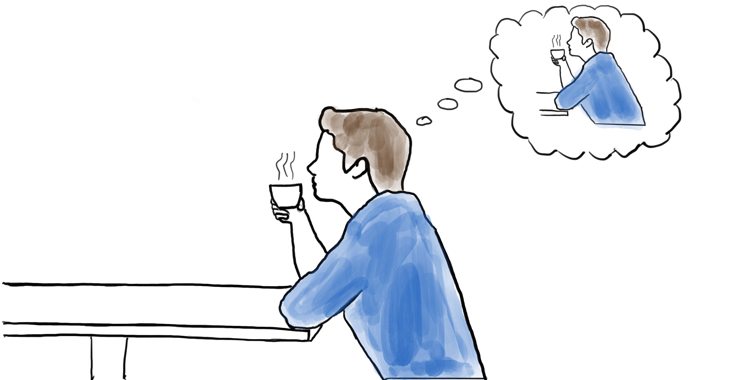
As much as I like the image of this guy drinking his coffee, we often are given the wrong messaging about ‘being present’.
The images we are given about being present tend to always look something like this: “sit and meditate”, “do your breath-work”, “go to a yoga class”. And while none of this is exactly ‘wrong’, it easily misses the point.
Think about that guy mindfully sipping his coffee. His actions and thoughts are one. He’s not lost in yesterday’s worries or tomorrow’s to-do list, his mind is engaged with the action that he is busy taking. He is not on autopilot reacting from old programming and this is the point – can you use meditation and yoga and breathwork not as an escape from “the real world” but as a way to practice how to interact with the reality of your everyday life?
Being consciously present really means that you are able to see the situation as it actually is. You’re able to see your old programming reacting in the same old way, and you’re also able to consciously decide whether the old reaction is the right one for this moment, or whether you want to try a new response.
“Drink your tea slowly and reverently, as if it is the axis on which the whole earth revolves – slowly, evenly, without rushing toward the future.” – Thich Nhat Hanh
“Meditation helps us to get out of our thoughts about the future and really be in the present moment.” – Tara Brach
“We wait for things to be different in order to feel okay with life. As long as we keep attaching our happiness to the external events of our lives, which are ever changing, we’ll always be left waiting for it.” – Tara Brach
“Stopping the endless pursuit of getting somewhere else is perhaps the most beautiful offering we can make to our spirit.” – Tara Brach
“There are some things we can’t choose, but in being present we can choose how we want to relate to them.” – Tara Brach
Being present really is the most productive state that you could possibly be in.
Today’s meditation is an exercise in presence, specifically becoming present with our physical senses. What do I see, what do I hear, what do I smell, taste and feel? And can I keep my mind engaged with what it is that I’m doing?
The point of the exercise is to carry that presence into the next thing that I’m doing. Paying attention to my senses or drinking my tea reverently is a great tool for reminding me to be present, but only being present while I meditate or drink my tea is not the point… the point is to carry that presence with me to my computer screen, to the boardroom and the dinner table too.
Here are some guiding mantras from Tara Brach to keep your present-moment practice thriving:
- Stop waiting for things to be different. Happiness isn’t found in some future utopia. It’s cultivated in appreciating the present moment, even the challenging ones.
- Let go of the chase. The constant striving for something else creates an undercurrent of dissatisfaction. Embrace the present moment, just as it is.
- Choose how you relate to your experiences. Life throws its curveballs, but you get to choose how you respond. Being present allows you to make conscious choices, not get pulled around by circumstance.
By cultivating present-moment awareness, we unlock a hidden wellspring of productivity, creativity, and connection. Remember, it’s not about achieving some unattainable state of zen, but about bringing a mindful focus to the simple act of being alive, in this very moment. So, take a deep breath, savor your next sip of coffee, and embrace the power of being present.
Have a great weekend peeps!
– pierre –
Today’s LIVE meditation is: Come to your senses.
A moment of reflection
(If you have the time, use this question as a journal prompt, because whenever you put pen to paper you’re wiring the neural pathways that create your new habits. But if you don’t have the time, just take a moment to reflect on your response.)
The Chase and the Wait: Reflect on Tara Brach’s insight: “We wait for things to be different in order to feel okay with life.” What are you currently waiting for before you’ll allow yourself to feel satisfied or happy? This might be a promotion, a relationship change, a financial goal, or even something as simple as the weekend. Write about why you’ve attached your well-being to this future outcome. Now, explore what it might look like to find appreciation and engagement in your current circumstances, even while working toward your goals. What small shifts in perspective could help you stop postponing your sense of contentment?
Today’s LIVE meditation
https://youtu.be/BMghZqT0kok 2024
https://youtu.be/eSbZGGv_f9I 2022
Q&A for deeper learning
Q1: How is being present actually more productive than using time management techniques?
Traditional productivity methods focus on organizing external tasks and schedules, but they often ignore the quality of attention you bring to those tasks. When you’re present, your thoughts and actions align, eliminating the energy drain of mental distraction. You work more efficiently because you’re fully engaged with what you’re doing, make fewer mistakes, and often discover creative solutions that emerge from focused attention. Presence doesn’t replace good planning—it makes your planning and execution far more effective.
Q2: I understand the concept, but how do I actually practice being present during busy, stressful days?
Start with your senses as anchors. Throughout the day, regularly ask yourself: “What do I see, hear, feel, smell, or taste right now?” This simple practice pulls your attention back to the present moment. You can do this while typing an email, walking to a meeting, or even during difficult conversations. The key is consistency—these micro-moments of presence accumulate and eventually become your default state rather than something you have to remember to do.
Q3: Doesn’t being present mean I’ll stop planning for the future or learning from the past?
Not at all. Being present means engaging fully with whatever you’re doing right now—whether that’s planning future projects or reflecting on past experiences. The difference is that when you’re present, you’re consciously choosing to think about the future or past, rather than being unconsciously pulled into worry or regret. You can plan more effectively when you’re not anxious about outcomes, and you can learn from the past without being haunted by it.
Q4: How do I know if I’m really present or just thinking I am?
True presence has distinct characteristics: your thoughts match your actions, you notice details you usually miss, time seems to flow differently (neither dragging nor racing), and you feel a sense of ease even during challenging tasks. If you’re genuinely present, you’ll catch yourself when your mind starts to wander rather than realizing hours later that you were on autopilot. It’s the difference between being aware of your awareness and simply going through the motions.
Q5: What’s the difference between being present and just focusing hard on something?
Focus often involves effort and tension—you’re trying to concentrate despite distractions. Presence is more like relaxed attention. When you’re present, focus happens naturally because you’re not fighting internal resistance or forcing your attention. You’re simply here, engaged with what is. Focus can be exhausting; presence is energizing because you’re not wasting mental energy on internal conflict between where you are and where you think you should be.
Q6: How can I stop my mind from constantly jumping to future worries or past regrets?
Recognize that this mental time-traveling is often a habit, not a necessity. When you notice your mind wandering to future anxieties or past mistakes, gently redirect it with questions like: “What can I actually do about this right now?” If there’s action to take, take it. If not, return your attention to your current experience. The goal isn’t to never think about past or future, but to do so consciously and purposefully rather than compulsively.
Q7: Can being present really help with decision-making and problem-solving?
Absolutely. When you’re present, you see situations more clearly because you’re not filtering everything through past assumptions or future fears. You have access to more information—including subtle cues you might miss when distracted—and you can respond from wisdom rather than react from old patterns. Many breakthrough insights come not from thinking harder, but from being more present with the situation at hand. Presence creates the mental spaciousness needed for creative solutions to emerge naturally.