Here’s a little inspiring nugget that’ll take you about 2 minutes to chew on. Now, if you’re hungry for the whole story and want to become a true connoisseur of this topic, our menu has all the delicious details you can handle!
A message from today’s meditation:
Silence… stillness… emptiness… all words trying to describe an essence that all of us know something about, and most of us have an uneasy relationship with. Lao Tzu called it “The Void”.
Throughout human history there have always been teachings about what is possibly found within that nothingness when we are able to surrender and go willingly, and today’s message describes it in the voice of Winnie the Pooh:
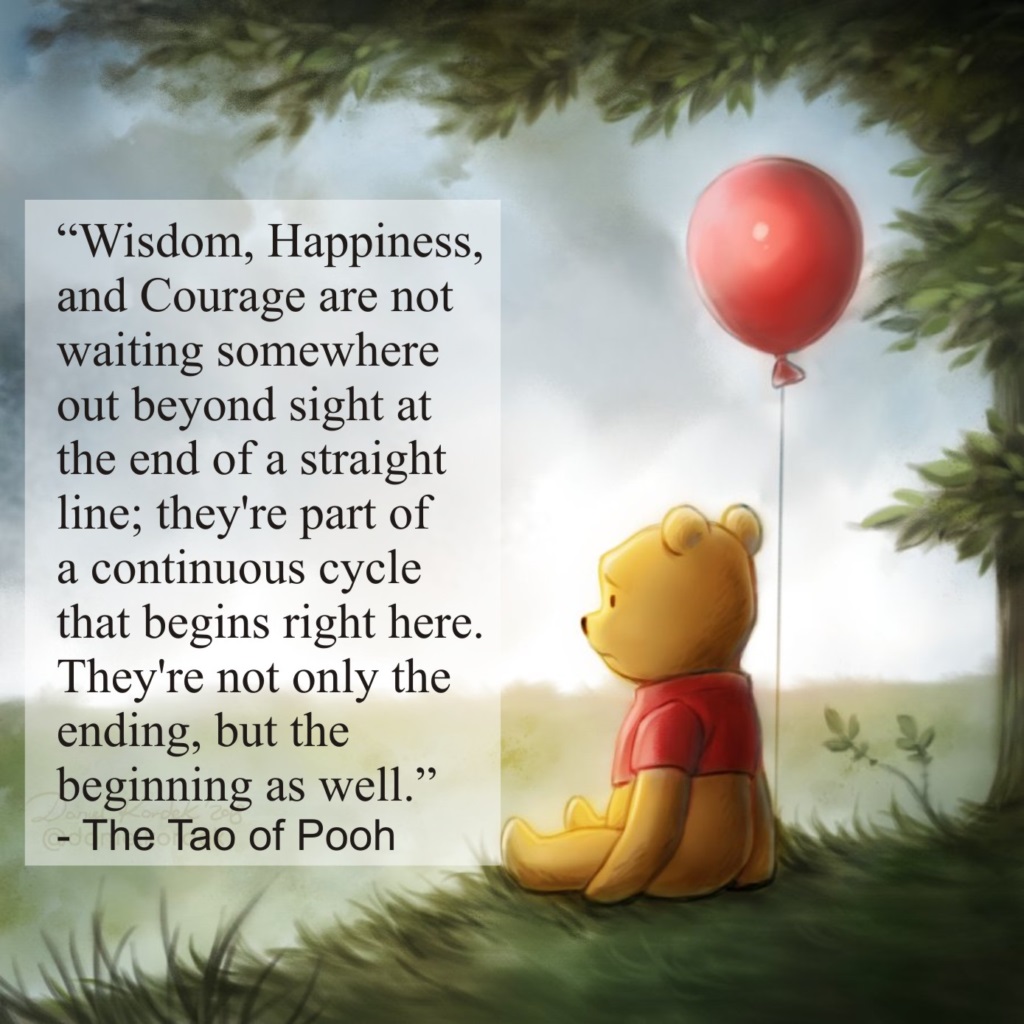
“Wisdom, Happiness, and Courage are not waiting somewhere out beyond sight at the end of a straight line; they’re part of a continuous cycle that begins right here. They’re not only the ending, but the beginning as well.” – The Tao of Pooh
“Like silence after noise, or cool, clear water on a hot, stuffy day – Emptiness cleans out the messy mind and charges up the batteries of spiritual energy. Many people are afraid of Emptiness however, because it reminds them of Loneliness. Everything has to be filled in it seems – appointment books, hillsides, vacant lots – but when all the spaces are filled, the Loneliness REALLY begins. Then the Groups are joined, the Classes are signed up for, and the “Gift-to-Yourself” items are bought. When the Loneliness starts creeping in the door, the Television Set is turned on to make it go away… but it doesn’t go away… So some of us learn to dive in instead, and after discarding the compulsions of the “Big Congested Mess”, we discover the fullness of Nothing.” – The Tao of Pooh
“…the adult is not the highest stage of development. The end of the cycle is that of the independent, clear-minded, all-seeing Child. That is the level known as wisdom. When the Tao Te Ching and other wise books say things like, “Return to the beginning; become a child again” that’s what they are referring to. Why do the enlightened seem filled with light and happiness like children? Why do they sometimes even look and talk like children? Because they are. The wise are “Children Who Know”. Their minds have been emptied of the countless minute somethings of small learning, and filled with the great wisdom of the Great Nothing, the Way of the Universe.” – The Tao of Pooh
There is wisdom to be found in “The Great Nothing”.
It’s a place where the countless “somethings” we have always placed so much importance on begins to dissolve, leaving us with a deeper sense of what’s real. And what’s more, the same process happens with what we see when we look at ourselves.
The nice, neatly wrapped little package we’ve always been trying to show the world starts to unravel and we come face to face with what’s inside, and this is why most people want to look away… because we’ve been taught to wear the masks, that the world will accept the pretty smile but not what’s underneath. And what makes it worse is that we started to believe it too! Don’t look away, don’t turn your head, stay…
Only if you give it enough time will you start to see through all of the softening layers, the raw and beautiful truth of the original YOU – who you’ve always been! With enough patience the “time will come when with elation you will greet yourself arriving at your own door, in your own mirror and each will smile at the others’ welcome.” (Derek Walcott)
And once the image in the mirror becomes beautiful to you, you won’t care about the world’s response any longer. You’ll have become “The Child” again, the independent, clear-minded, all-seeing child. “A child who knows”.
A few questions for self-reflection:
- What “somethings” have I been clinging to that no longer serve me?
- Am I living authentically, or am I wearing a mask for the world?
- When was the last time I truly embraced silence and stillness?
- Can I find beauty in the “emptiness” within myself?
Push off from the dock and come and drift away with us for a bit in the stillness that is your original being.
– pierre –
Today’s LIVE meditation is: Finding silence.
(credit: https://www.benjaminhoffauthor.com/ )
A moment of reflection
(If you have the time, use this question as a journal prompt, because whenever you put pen to paper you’re wiring the neural pathways that create your new habits. But if you don’t have the time, just take a moment to reflect on your response.)
The article discusses the “fullness of Nothing” and how discarding compulsions can lead to this discovery. Reflect on a time in your life when letting go of something (an expectation, a possession, a belief) unexpectedly brought a sense of richness or clarity. What did you learn from that experience about the potential within “nothingness”?
Today’s LIVE meditation



Q&A for deeper learning
1. What is meant by “the fullness of Nothing” in the context of this article? The “fullness of Nothing” refers to the idea that when we let go of our need to conform and fill our lives with external “somethings,” we discover a deeper, richer essence within the apparent emptiness. It’s not about literal nothingness, but rather the potential and wisdom found when the clutter of the mind and external pressures dissolves.
2. The article mentions Lao Tzu and “The Void.” What is this concept referring to? Lao Tzu’s “The Void” is similar to the “fullness of Nothing.” It represents a state of silence, stillness, and emptiness that is not devoid but full of potential. It’s the space from which everything arises, and by connecting with it, we can find clarity and wisdom.
3. What is the meaning behind Winnie the Pooh’s quote: “Wisdom, happiness, and courage are not waiting somewhere out beyond sight at the end of a straight line; they’re part of a continuous cycle that begins right here. They’re not only the ending, but the beginning as well.”?
This quote suggests that these desirable qualities aren’t destinations to be reached but are inherent within our present experience. They exist in a cyclical nature, meaning that endings can lead to new beginnings, and the potential for wisdom, happiness, and courage is always accessible in the present moment, not something to be sought externally or in the future.
4. The article states, “emptiness cleans out the messy mind and charges up the batteries of spiritual energy.” How does emptiness achieve this?
By embracing silence and stillness, the constant noise and clutter of our thoughts can subside. This creates space for clarity, much like how clearing out a physical space can bring a sense of calm. This mental and emotional clearing can then revitalize our inner “spiritual energy” by allowing us to connect with a deeper sense of self and the universe.
5. What does it mean to “return to the beginning; become a child again” as mentioned in the article?
Of course this doesn’t mean becoming physically younger, but rather regaining the qualities of a child: a clear mind, a sense of wonder, and an unburdened perspective. It’s about shedding the layers of societal conditioning and the “small learning” of adulthood to access a more fundamental and wise state of being.
6. The text refers to the wise as “children who know”. What does this imply?
“Children who know” suggests that the truly wise have a childlike openness and clarity of perception, combined with a deep, intuitive understanding (“knowing”) that comes from emptying the mind of unnecessary complexities and connecting with a more profound truth or “The Great Nothing.”
7. What is meant by “the nice, neatly wrapped little package we’ve always been trying to show the world starts to unravel”?
This refers to the facade or the carefully constructed image we present to others. As we delve into ourselves and the “emptiness,” these superficial layers begin to dissolve, revealing our more authentic, perhaps rawer, selves that we might have been hiding.